
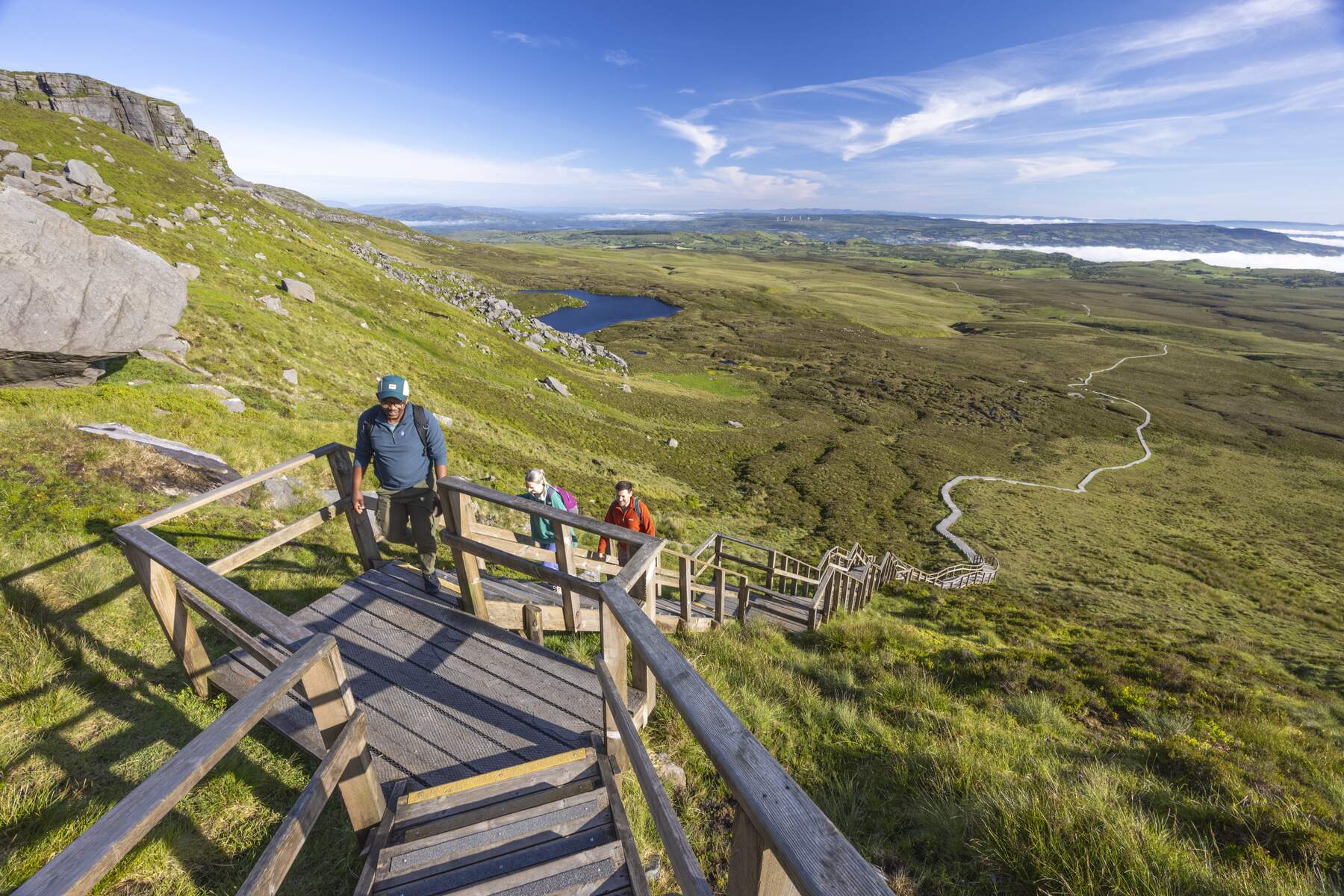
Overview
Ballintempo Forest stretches across the western part of County Fermanagh, forming part of the Marble Arch Caves Global Geopark and the Cuilcagh Lakelands UNESCO Global Geopark. The 8,500 ha woodland is a patchwork of conifer plantation, open blanket‑bog, wooded gullies and striking sandstone crags. Its signature route, the Aghanaglack Walk, is a 7 mile (11 km) circular trail that showcases geology, archaeology and wildlife. Access is free, though a modest charge may apply at the main car‑park on Boho Road.
History & Heritage
The blanket bog that dominates much of the forest began to accumulate 5‑6 000 years ago, when water‑logged conditions slowed plant decay and peat formed. For generations the bog supplied turf for domestic fuel, a tradition still visible during the summer months when locals cut peat.
At the heart of the walk lies the Aghanaglack Dual Court Tomb, a rare Neolithic burial monument dated to c. 4 000–2 000 BC. The tomb consists of two small courtyards at either end of a stone‑lined gallery, originally roofed with massive slabs and covered by earth to create an imposing mound. Interpretive panels near the site explain its construction and ritual significance.
Brimstone Rock, a massive sandstone outcrop, dominates the landscape. Though its name suggests sulphur, none is present; local folklore records that the rock served as a mass rock for clandestine Catholic worship in the mid‑17th century. From its bench you can see the stepped profile of Cuilcagh Mountain (665 m) and the surrounding lakelands.
Getting There
By car – From Enniskillen follow the A46 towards Belleek, turn left onto the B81 Derrygonnelly road and continue to the Boho turn‑off. After passing Boho Community Centre, follow signs for the Aghanaglack car‑park (approximately 5 mi / 8 km from Enniskillen). From Belcoo, take the Aughrim Road and Gaedrum Road, following the signs to the chambered cairn; the car‑park sits just off the Boho‑Ballintempo road.
Public transport – The nearest bus stop is in Boho; from there a local taxi can reach the forest car‑park. No regular train service serves the site.
Walking the Aghanaglack Loop
The walk is marked with black way‑markers and is part of the Ulster Way, which threads through the forest. The route is moderate in difficulty and takes most walkers 2½–3 hours. Highlights appear in this order:
- Start at the Aghanaglack car‑park and head onto the forest track.
- Early views of Cuilcagh’s stepped silhouette.
- Brimstone Rock – pause on the bench for panoramic scenery.
- Lough Blockent – a reed‑lined lake ideal for a quiet break or bird‑watching.
- Aghanaglack Dual Court Tomb – explore the Neolithic chambers and read the interpretive panels.
- Return via the blanket‑bog and conifer tracks, completing the circular loop.
Wildlife & Seasonal Highlights
Birds: Merlin and hen‑harrier are regular raptors; winter brings occasional barn‑owl sightings. Butterflies: Spring walks often reveal Orange‑Tip butterflies flitting among the bog flora. Peat cutting: In summer you can watch locals harvesting peat – a living tradition that shapes the landscape. Other fauna: Irish hares are known to frequent the upland areas, though sightings are occasional.
Practical Tips & Accessibility
| Attribute | Details |
|---|---|
| Distance | 7 mi / 11 km (some sources list 7.8 mi / 12 km) |
| Difficulty | Moderate |
| Terrain | Mixed – conifer tracks, blanket bog, sandstone outcrops |
| Way‑marking | Black posts throughout the loop |
| Parking | Small car‑park at the Aghanaglack entrance (small charge may apply) |
| Dogs | Must be kept under control; owners should take waste away |
| Access | Not wheelchair accessible; occasional temporary closures for forest works – check signage |
| Best time to visit | Late spring to early autumn for wildflower displays and active peat‑cutting; winter offers stark, atmospheric scenery |
| Facilities | Picnic table near car‑park; bench at Brimstone Rock; interpretive panels at the tomb |
| Footwear | Sturdy walking shoes recommended; the bog sections can be wet underfoot |
Nearby Attractions
After your walk, consider extending the day with a short drive to other Geopark sites:
- Castle Coole – an 18th‑century National Trust house with formal gardens.
- Crom Castle – historic fortified house set on the shores of Upper Lough Erne.
- Belmore Forest and Big Dog Forest – neighbouring woodlands offering additional trails and wildlife spotting.
What to See & Do
| Feature | Why it matters |
|---|---|
| Brimstone Rock | Bench and interpretive panel; panoramic vista of Cuilcagh Mountain and the lakelands |
| Aghanaglack Dual Court Tomb | Rare Neolithic monument offering insight into early Irish ritual life |
| Blanket Bog | Live example of post‑glacial peat formation; seasonal peat‑cutting can be observed |
| Lough Blockent | Reedy shoreline ideal for quiet contemplation and bird‑watching |
| Upland Birds | Merlin and hen‑harrier sightings are common along the track |
| Geology | Sandstone outcrops, glacially‑shaped valleys and the distant Cuilcagh plateau illustrate the area’s complex geological history |
The walk begins at the car‑park on Boho Road. A black‑marked route leads onto forest tracks that weave through conifer, open bog and rocky sections. Early on, the path climbs gently, offering the first glimpse of Cuilcagh’s stepped silhouette. The trail then reaches Brimstone Rock, where a bench invites a pause to soak in the sweeping scenery.
Continuing onward, the route skirts the reed‑lined Lough Blockent, a perfect spot for a quiet break or bird‑watching. The path then turns toward the Aghanaglack Dual Court Tomb; interpretive panels provide context before you explore the ancient stone chambers. The circuit loops back through the bog and forest, completing the 7‑mile circuit.
Practical Information
| Attribute | Details |
|---|---|
| Distance | 7 mi / 11 km (some sources list 7.8 mi / 12 km) |
| Difficulty | Moderate |
| Terrain | Mixed – conifer tracks, blanket bog, sandstone outcrops |
| Way‑marking | Black posts throughout the loop |
| Parking | Main car‑park on Boho Road (small charge may apply) |
| Best time to visit | Late spring to early autumn for wildflower displays and active peat‑cutting; winter offers stark, atmospheric scenery |
| Facilities | Picnic table near car‑park; bench at Brimstone Rock |