
Overview
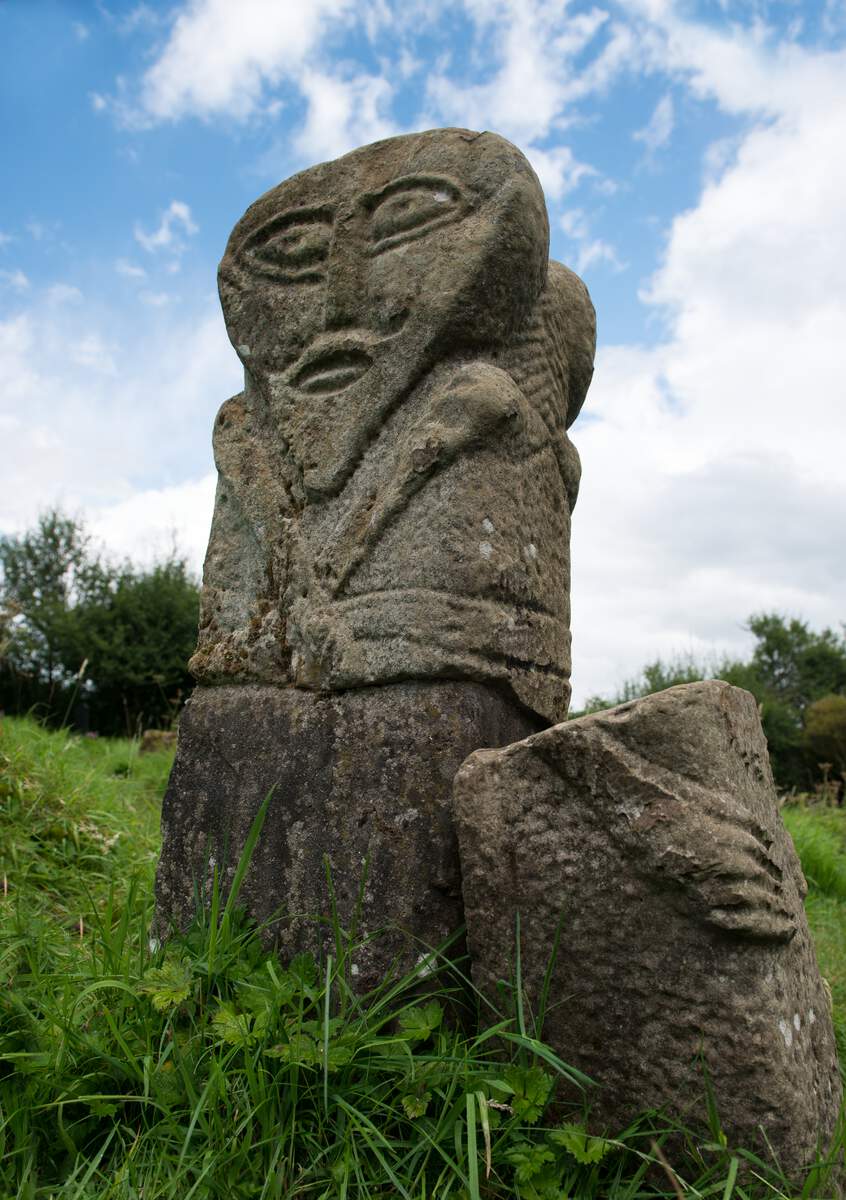
Boa Island sits in the northern reaches of Lower Lough Erne, linked to the mainland by bridges at each end. Amidst its modest graveyard, Caldragh Cemetery, stand two enigmatic stone figures that have fascinated scholars and visitors for nearly two centuries. The larger, two‑sided sculpture is commonly called the Dreenan Figure or Janus Stone, while the smaller, single‑sided piece is known as the Lustymore Man. Both are free to view and remain a focal point for anyone interested in Ireland’s early‑medieval mythology and stone‑carving traditions.
History
The Dreenan Figure was first recorded in 1841 by the 19th‑century painter and antiquarian George Victor Du Noyer, who sketched the stone in a series of pencil drawings. It entered academic awareness in 1933 when archaeologist Dorothy Lowry‑Corry documented the figure during a survey of the island’s historic sites. The statue was originally half‑buried in a thicket within the cemetery; it was later lifted onto a plinth where it now stands.
Scholarly opinion has shifted over time. Early interpretations placed the figures in the Iron Age, suggesting a pagan deity or a Roman‑inspired Janus idol. Modern debate leans toward an early‑medieval origin, largely because both statues were discovered in early Christian burial grounds—a context that would be unlikely for overtly pagan idols. The larger figure’s twin faces, each bearing a large oval eye, straight nose, and a half‑open mouth with a protruding tongue, have been linked to the war goddess Badhbh (the hooded crow). The island’s name, Inis Badhbha, literally means “Badhbh’s Island,” reinforcing this mythic connection.
The Lustymore Man, as its name implies, originated on neighbouring Lustymore Island. It is more weathered and less intricately carved, displaying a single face with a straight nose and open mouth, and its arms rest on its knees. After a brief stay in the home of Lady Ernestine Hunt, the figure was moved to Caldragh Cemetery for safekeeping, where it now stands beside its larger counterpart.
What to See & Do
- The Dreenan Figure (Janus Stone) – Examine both sides of the two‑sided stone. One side shows a tongue partially protruding, the other a simple open mouth. The heads merge directly onto the torso, which is a square block with crossed arms and a belt. A groove at the top of each head is traditionally used for coin offerings.
- The Lustymore Man – Observe the more weathered, single‑sided figure. Its plain carving offers a contrast to the Dreenan Figure’s intricate interlace hair motif and double‑faced design.
- Base Discovery – Near the Dreenan Figure lies a recently uncovered base, half‑buried in the ground, hinting at the original placement of the stone.
- Landscape Views – While the focus is on the stones, the surrounding Lough Erne scenery provides tranquil water vistas and opportunities for quiet reflection.
Practical Information
| Opening Times | Details |
|---|---|
| All year | Open daily |
| Admission | Fee |
|---|---|
| General public | Free (parking charges may apply) |
Getting there
From Enniskillen, follow the A32 north‑west, continue onto the B82, and watch for signs to Boa Island/Kesh. The drive takes roughly 30 minutes. The site is located at 565 Boa Island Road, Boa Island, County Fermanagh BT93 8AD. A Google Maps pin is available here.
Parking
A small lay‑by exists beside the cemetery on a working farm. Parking is limited; visitors are asked to park close to the road to avoid obstructing farm traffic.
Accessibility
The cemetery is historic and lacks formal pathways. The ground is uneven, making wheelchair access difficult. Visitors with limited mobility should be prepared for a short, uneven walk from the car park to the stones.
Dog policy
Because Caldragh Cemetery remains an active burial ground, dogs are not encouraged.
Family considerations
The site is not ideal for very young children due to the uneven terrain and the solemn nature of the graveyard. Older children with an interest in mythology may find the figures captivating.
Further reading
- The Northern Ireland Place‑Name Project explains the island’s name origin: Inis Badhbha.
- For a scholarly perspective on the figures’ dating, see Dorothy Lowry‑Corry’s 1933 analysis (available via JSTOR).
Visiting the Janus Stones offers a rare chance to stand before two mysterious stone idols that have survived centuries of myth, scholarly debate, and the ever‑changing Irish landscape. Their free entry and remote, contemplative setting make them a rewarding stop on any cultural itinerary through County Fermanagh.