
Overview
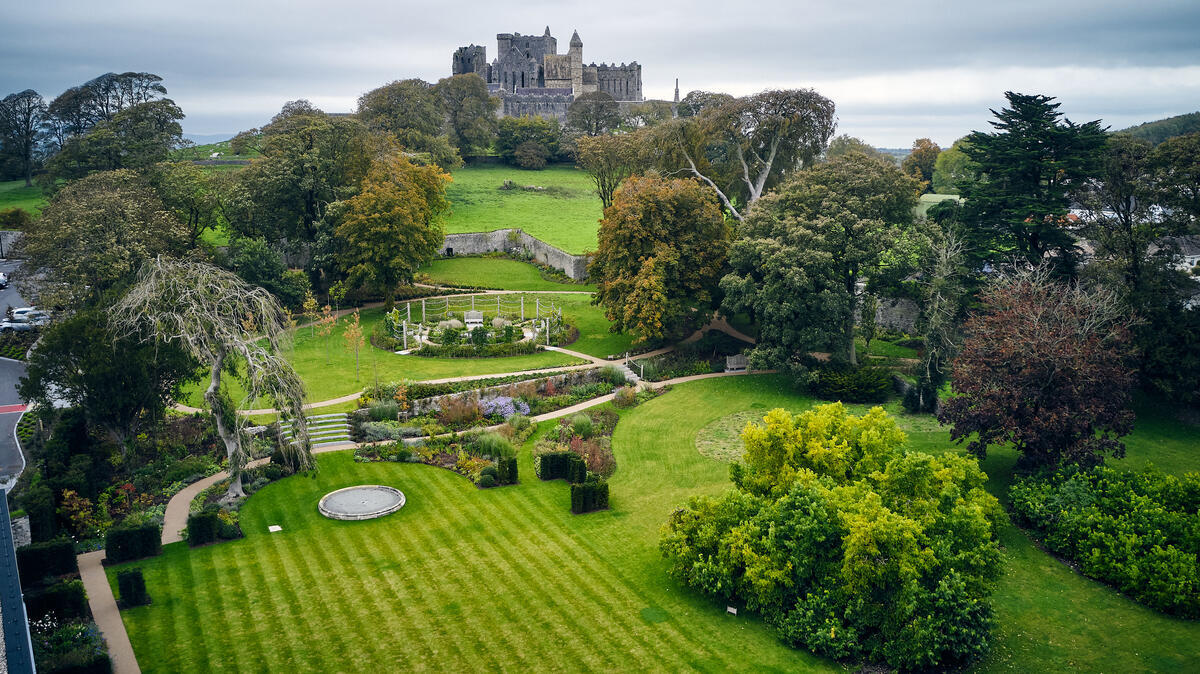
Cashel (Irish: Caiseal, “stone fort”) lies in the heart of County Tipperary’s fertile Golden Vale. With just under 5,000 residents, the town is easily explored on foot and centres around the iconic Rock of Cashel – a dramatic limestone promontory that dominates the skyline. Below the rock, Main Street bustles with cafés, pubs and craft shops, while the Brú Boru Heritage Centre at the foot of the hill showcases Gaelic language, music and folklore. Well‑served by road, bus and taxi, Cashel is a natural stop on any Munster road‑trip.
History / Background
The site’s name hints at its pre‑Christian origins as a stone fort. Archaeology shows the hill was the seat of the Eóganachta kings from the 4th century, and legend records St Patrick converting King Aenghus there in the 5th century. In 978 AD Brian Boru was crowned High King on the rock, and in 1101 the ruling king gifted the fortress to the Church. Over the 12th and 13th centuries a remarkable ecclesiastical complex was built:
- a 28 m round tower (c. 1100),
- the Romanesque Cormac’s Chapel (1127‑1134) with Ireland’s only surviving frescoes,
- a 13th‑century Gothic cathedral, and
- the 15th‑century Hall of the Vicars Choral. The precinct also contains a high cross, a 15th‑century tower house and the ruined St Dominic’s Abbey (1243). Though the complex survived the Cromwellian sack of 1647, it later endured vandalism in the 1760s. Today it is a National Monument managed by the Office of Public Works and one of Ireland’s most photographed heritage sites.
Legends and Myths
Local folklore adds a dramatic layer to the stone walls. One tale says the Devil, fleeing St Patrick, tried to crush the saint by hurling a chunk of rock from the nearby Devil’s Bit Mountain; the stone landed where the Rock of Cashel now stands. Another version links the outcrop to the “missing” summit of Mangerton in County Kerry. These stories, together with the historic conversion of King Aengus by St Patrick, give the site a mythic aura that still captures visitors’ imaginations.
What to See & Do
The Rock of Cashel complex
- Round Tower – an imposing 28 m stone silhouette; the entrance sits at ground level due to its shallow foundations.
- Cormac’s Chapel – accessed by guided tour only; admire rare 12th‑century frescoes and the intricately carved north doorway, protected by a climate‑controlled enclosure.
- Gothic Cathedral – walk the aisle‑less nave, view the 7‑ft St Patrick’s Cross in the undercroft and see remnants of the once‑grand vaulted roof.
- Hall of the Vicars Choral – the visitor entrance and museum, housing the original high cross and artefacts from the medieval precinct.
- High Crosses & Graveyard – stroll among medieval stone slabs, including the restored Scully’s Cross.
Town attractions
- Brú Ború Cultural Centre – exhibitions, traditional music, dance performances and a small museum that deepens understanding of Irish language and folklore.
- Main Street & Town Trail – brightly painted shopfronts, a historic fountain, and eateries such as Grogan’s Café, Saffron, Bowes and Spearman’s Tearoom. The trail links the heritage centre, the former courthouse and surviving 19th‑century stone walls.
- St John the Baptist Catholic Church (1795) faces the Church of Ireland cathedral across Friar Street.
Outdoor activities
- Walking & Cycling – the Tipperary Heritage Way (55 km) passes through Cashel; the 11 km Cashel‑Golden section offers gentle riverside paths, while the 3.7 km Devil’s Bit Loop provides panoramic views of the Galtee Mountains.
- Angling – the River Suir is a prime salmon and trout fishery; licences are available at Casale 2000 Sports Shop.
- Golf – try the Cashel driving range located 3 km north of town.
Visitor Experience
- Audio‑visual presentation – a short AV show at the visitor centre introduces the site’s history and legends.
- Guided tours – OPW runs regular guided tours; a separate fee applies for the Cormac’s Chapel tour, which must be booked at the entrance.
- Stroller advice – the climb to the main entrance is steep; families with very young children may prefer a baby‑carrier.
- Crowd tip – summer months attract large coach groups. Arriving early (opening time) or later in the afternoon helps avoid the busiest periods.
- OPW Heritage Card – holders receive free entry to the Rock of Cashel and other OPW sites.
Nearby Attractions
- Hore Abbey – Ireland’s last medieval Cistercian monastery, visible from the Rock’s summit and a short walk away.
- Athassel Priory – a large 13th‑century Augustinian priory a few kilometres south of Cashel; accessible via a marked trail.
- Cahir Castle – a well‑preserved 13th‑century fortress on the River Suir, reachable by a 20‑minute drive.
Practical Information
- Opening times: Apr‑Oct 09:30‑17:30 (last entry 17:00). Nov‑Mar 09:30‑16:45 (last entry 16:15). Check the OPW website for seasonal variations.
- Tickets: Entry is ticketed on‑site; a combined ticket includes the Hall of the Vicars Choral museum and the audio‑visual show. Guided tour of Cormac’s Chapel is an extra charge.
- Parking: Pay‑on‑spot parking is available at the base of the Rock. A larger free car park exists in the town; visitors can walk the 500 m from there to the site.
- Accessibility: The main precinct has hand‑rails and limited wheelchair access, but the round tower and chapel interiors are not accessible due to historic preservation.
- Getting there: Cashel lies on the N74 and is reachable by regular Bus Éireann services from Limerick, Cork and Dublin. The nearest train station is Thurles (≈20 km north); Bus 394 connects the station to Cashel. Taxis are readily available in town.
- Facilities: Restrooms, a café, and a gift shop are located within the visitor centre. Picnic tables are provided near the River Suir.
- Contact: +353 62 61437.
Whether drawn by the legends of St Patrick, the striking medieval stonework, or the rolling Golden Vale scenery, the Rock of Cashel offers a compact yet unforgettable glimpse into Ireland’s rich past.