
Overview
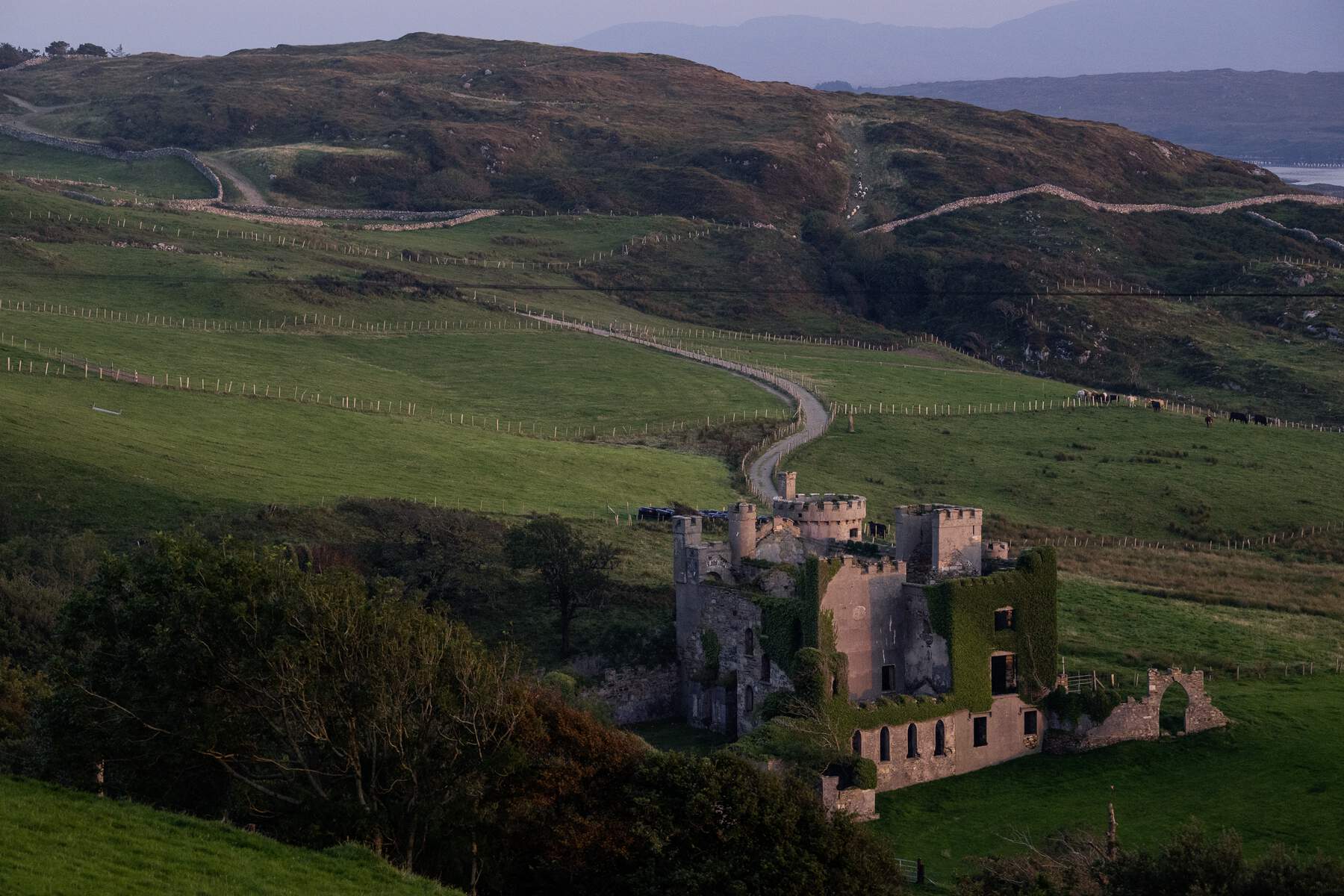
Isert Kelly Castle, often referred to simply as Castle Kelly, dominates a modest bawn in the townland of Castlepark, about 5 km southwest of the village of Kilchreest in County Galway. The tower house rises roughly 21 m (about 70 ft) and is set within a square enclosure measuring 60 m on each side. Designated a National Monument, the ruin is a striking silhouette against the rolling pastureland, visible from the roadside and, with the landowner’s permission, from a short walking path.
The site is a focal point for the Galway Archaeological Field School, which has been excavating the surrounding courtyard since 2014. Their work has revealed a complex of secondary buildings – a hall, stables, cottages and barns – that once supported a thriving medieval estate. Visitors can therefore appreciate not only the tower house itself but also the broader layout of a late‑medieval Irish stronghold.
History
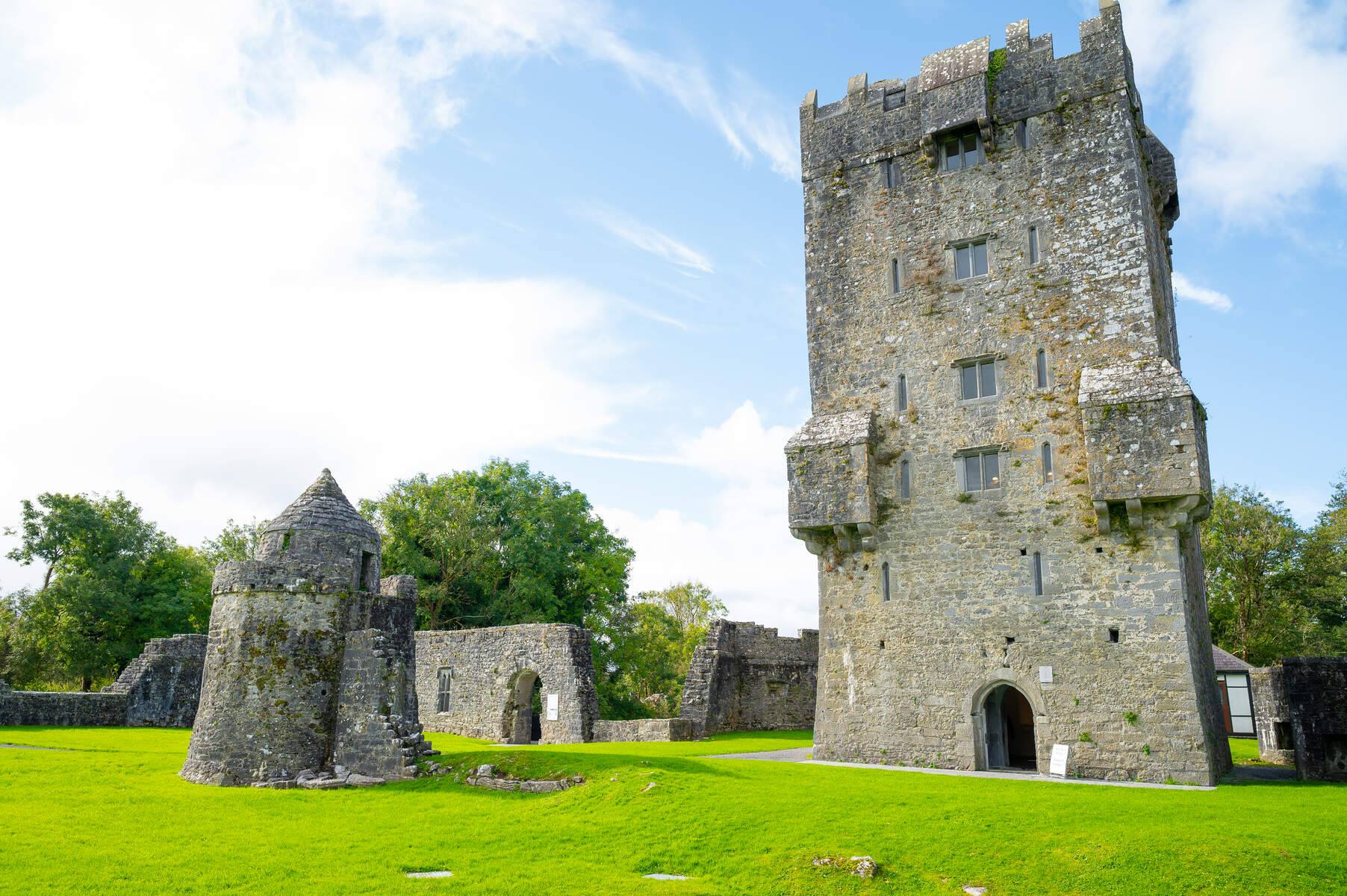
The castle’s origins lie in the early 1400s when the MacHubert Burkes, a branch of the powerful de Burgo (Burke) family, erected the tower house as their principal seat. The Burkes claimed descent from Hubert, son of the 13th‑century Hiberno‑Norman knight Richard Óg de Burgh, a lineage that underscores the castle’s aristocratic pedigree.
During the turbulent Nine Years’ War, the Ó Doṁnaill (O’Donnell) clan burned the castle in 1596. A later refurbishment is evident in the third‑storey fireplace dated 1604, bearing the initials “W.H.” – likely William Henry, a MacRedmond lord who inherited the property after the MacHuberts. Following the Cromwellian conquest, the castle was confiscated and granted to Dudley Persse, an English settler who became a major landowner in Galway. The Persse family retained the estate into the 19th century, though there is little evidence they ever occupied the tower house.
Archaeological investigations between 2014 and 2024 have dramatically expanded our understanding of the site. Excavations uncovered a late‑medieval hall, a well, a postern gateway, extensive cobbled surfaces, and thousands of artefacts ranging from pottery shards to shotgun cartridges. These finds suggest the castle functioned as a hub of economic and social activity, challenging earlier assumptions that tower houses were purely defensive.
What to See & Do
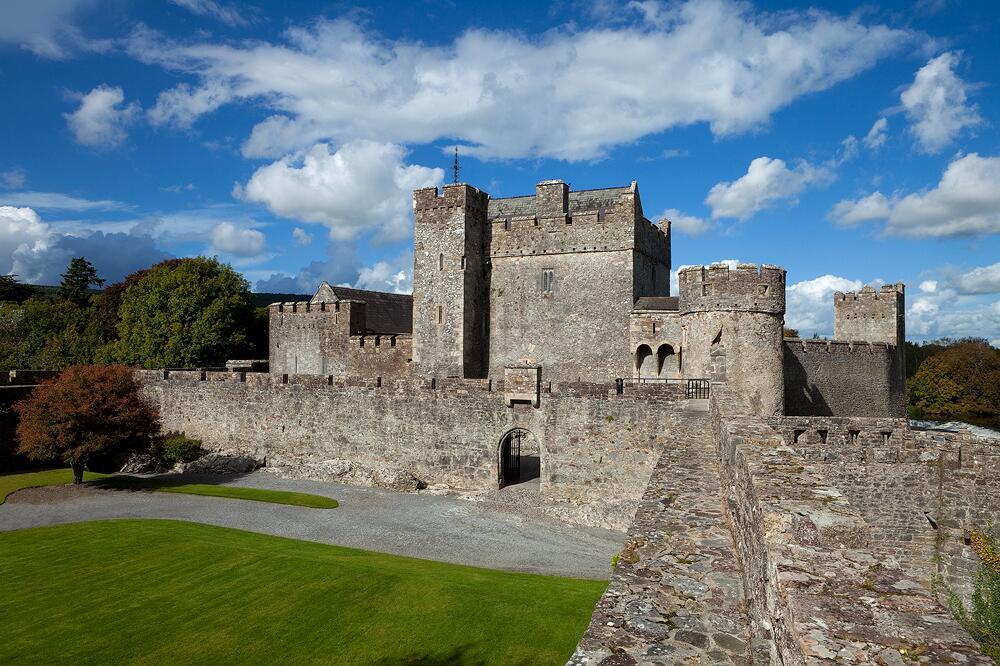
While the interior of the tower house is not accessible, the exterior offers several points of interest:
- The Tower House – The three‑storey stone structure retains its vaulted first floor, arcade‑lined second floor, and the 1604 fireplace on the third floor. The stonework, with its narrow slit windows and crenellated parapet, exemplifies classic Irish tower‑house architecture.
- The Bawn – The surrounding square enclosure, still clearly defined by low earthworks, hints at the original defensive perimeter. Walking the perimeter (where permitted) provides a sense of the scale of the original estate.
- Archaeological Features – Visible foundations of secondary buildings can be spotted in the pasture, especially after a dry spell when the ground dries and outlines emerge.
- Scenic Views – The site sits on gently undulating farmland, offering panoramic views of the surrounding countryside, including the nearby River Corrib valley.
Photography enthusiasts will find ample opportunity for dramatic shots, especially at sunrise when the low light accentuates the stone’s texture. The location is also a useful waypoint for cyclists and walkers exploring the Kilchreest area.
Visiting Tips
- Access – The nearest public road is the R345, which passes within a few hundred metres of the bawn. A lay‑by opposite the gate provides limited parking; there is no formal car park.
- Permission – As the property is privately owned, the gate is locked. Visitors may request permission from the landowner for a closer approach; local farms are generally accommodating if you ask politely.
- Dog policy – Dogs are allowed on the public lay‑by but must be kept on a leash while near the castle to protect the fragile stonework.
- Facilities – A small café and public restroom are available in Kilchreest, a short walk away. For a wider range of services, head to Gort (≈12 km north).
- Seasonal view – Winter gives a stark, atmospheric backdrop; summer brings lush green fields. Dress for the weather and be prepared for uneven ground.
Nearby Attractions
- Aughnanure Castle – A well‑preserved 16th‑century tower house on the shores of Lough Corrib, about 30 km north‑west.
- Abbeyknockmoy – The ruins of a Cistercian abbey set in tranquil countryside, roughly 20 km east of Castle Kelly.
- River Corrib – Follow the river’s course for scenic walks and angling opportunities.
Practical Information
Isert Kelly Castle is not open to the public; the property is privately owned and the gate is locked to protect the structure. However, the castle can be viewed from the roadside, and visitors may request permission from the landowner for a closer approach. The site is located at the coordinates 53.158021 N, 8.718886 W.
Admission – There is no charge for viewing the exterior from the public road.
Further Reading – For detailed archaeological reports, see the Galway Archaeological Field School publications. The Visit Galway page for Isert Kelly Castle is currently unavailable.
Castle Kelly stands as a testament to the layered history of Galway’s landed families, from the medieval Burkes to the Persse estate of the 18th century. Even without interior access, the tower house’s silhouette and the surrounding archaeological landscape provide a vivid window into Ireland’s feudal past.