
Overview
Dartrey Forest, once the sprawling estate of the Dawson family, lies a few kilometres south‑east of Cootehill in County Monaghan. Managed today by Coillte as a commercial forest, the area is a patchwork of ancient woodlands, shimmering lakes, and historic stonework. The Dromore River threads through a series of linked loughs, creating reflective water‑edges that change colour with the seasons. Recent enhancements – new way‑marked paths, upgraded lighting and a whimsical play zone called Erica’s Fairy Forest – make the forest an inviting destination for walkers, history buffs and families alike.
History
The land that now forms Dartrey Forest was the heart of the Barony of Dartrey and the seat of the Dawson family, who held the title Earl of Dartrey from 1866 until the line died out in 1933. The original house, known as Dartrey House, was demolished in 1946; only the stables and fragments of the farmyard survive. Around the estate stand several monuments that chart the area’s layered past:
- Dawson Monument – a neo‑Classical column designed by James Wyatt and erected circa 1808, positioned just outside the forest gate along the R188.
- Famine Wall – a low stone wall that runs half‑way along the Cootehill‑to‑Rockcorry road, a stark reminder of the Great Famine’s impact on the landscape.
- Dawson Mausoleum (The Temple) – perched on Black Island, this roofless Pantheon‑inspired structure was also designed by Wyatt in 1770. Though it never housed remains, it remains a striking example of 18th‑century Irish architecture and is currently the focus of local conservation work.
- Dartrey Church of St John the Evangelist – a neo‑Gothic Church of Ireland building dating from the 1720s, still active for worship.
The estate’s original demesne was centred on a neo‑Elizabethan castle built in the 1840s for the 3rd Baron Cremorne. After a fire in 1856 the house was rebuilt, only to be sold off in 1937 and finally demolished a decade later. Today, the forest’s rolling terrain and water‑bound scenery echo the grandeur of the former estate while offering a tranquil retreat.
What to See & Do
Walking Trails
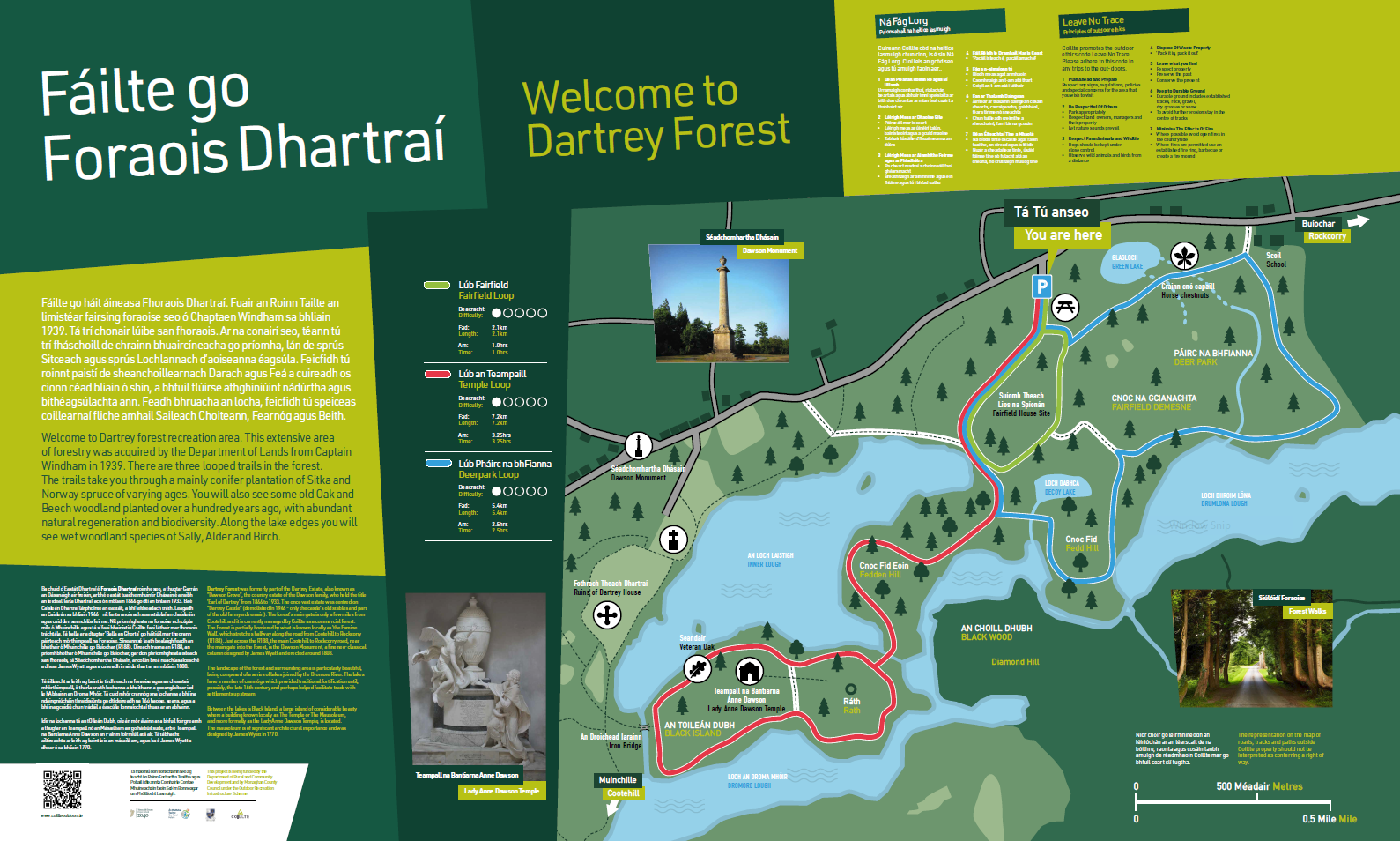
Dartrey Forest boasts three main marked loops, each colour‑coded on the ground and suitable for a range of abilities:
| Trail | Length | Markers | Approx. Time | Difficulty |
|---|---|---|---|---|
| Fairfield Loop | 2 km | Green | ~1 hour | Easy |
| Deer Park Loop | 5 km | Blue | ~2½ hours | Moderate |
| Temple Loop | 7 km | Red | ~3 hours | Moderate |
The Temple Loop is particularly rewarding for history lovers, as it passes the Dawson Mausoleum on Black Island and the iron bridge that links the island to the mainland. The Deer Park Loop skirts the inner lough, offering chances to spot local wildlife, while the Fairfield Loop provides a gentle introduction for families and casual walkers.
Key Attractions
- Black Island – a large, wooded island in the centre of the lake system, home to the roofless mausoleum and the iron bridge (currently awaiting restoration). The island’s quiet paths make it an ideal spot for a picnic.
- Dawson Monument – visible from the main road, this column marks the historic entrance to the estate and makes a striking photo opportunity.
- Erica’s Fairy Forest – a newly installed play area featuring whimsical wooden structures, perfect for children to explore safely.
- Famine Wall – walk alongside this historic wall to feel the weight of 19th‑century hardship while enjoying the surrounding scenery.
- Dartrey Church – located on the edge of the old demesne, the church’s neo‑Gothic architecture can be admired from the nearby trail.
Wildlife & Landscape
The forest’s mixed‑species woodlands support a variety of birds, including willow warbler, goldfinch and occasional buzzard. The lakes attract waterfowl such as teal, mallard and the occasional swan. Seasonal wildflowers carpet the forest floor in spring, while autumn brings a blaze of amber and crimson foliage.
Practical Information
Dartrey Forest is accessed via the R188 from Cootehill. After passing the Dawson Monument on the left, continue for about 1.5 km; the car‑park sits on the right‑hand side, marked with signage for the main entrance. Parking is free and suitable for standard cars and small vans.
The forest is open year‑round; there are no fixed opening hours, and entry is free. Trail markers are maintained by Coillte, and the recent pathway upgrades make the routes accessible for most visitors, including those with limited mobility, though some sections (e.g., the iron bridge to Black Island) remain uneven.
A downloadable trail map is available from Coillte: Download map here. For the latest information, visit the official Coillte page: Dartrey – Coillte.
Public transport options are limited; the most convenient approach is by car. The nearest towns, Cootehill and Rockcorry, provide basic amenities such as cafés, shops and fuel stations.
Accessibility – The forest’s main pathways have been resurfaced and now feature smoother surfaces, making the Fairfield Loop suitable for wheelchair users. The more rugged sections of the Deer Park and Temple Loops may present challenges for those with reduced mobility.
Nearby facilities – A small visitor car‑park, picnic tables and public restrooms are located near the main entrance. The nearby towns of Cootehill and Rockcorry offer additional dining and accommodation options for longer stays.
Enjoy the blend of natural beauty and layered history that makes Dartrey Forest a unique slice of Monaghan’s heritage.