
Overview
Nestled on the floodplain of the River Tolka, the National Botanic Gardens (Irish: Garraithe Náisiúnta na Lus) spread over 19.5 hectares of meticulously curated landscape. Home to roughly 20 000 living plants and millions of dried specimens, the gardens are a living laboratory and a beloved public park. Entry is free, making it one of Ireland’s most visited attractions and the second most visited free attraction in the country. Whether you are a horticultural enthusiast, a family looking for a relaxed day out, or a photographer chasing seasonal colour, the Botanic Gardens offer a calm retreat just three kilometres from Dublin’s bustling centre.
History
The gardens were founded in 1795 when the Dublin Society (later the Royal Dublin Society) received a parcel of land from the Irish Parliament. Originally intended to advance agricultural, medicinal and dye‑plant knowledge, the site quickly became a centre for scientific research. Early directors Walter Wade and John Underwood laid out the original plan, and the iconic double line of yew trees known as “Addison’s Walk” still survives from that era. In 1877 the gardens passed into State care and were renamed the Royal Botanic Gardens; they acquired their present name after the establishment of the Irish Free State in 1922.
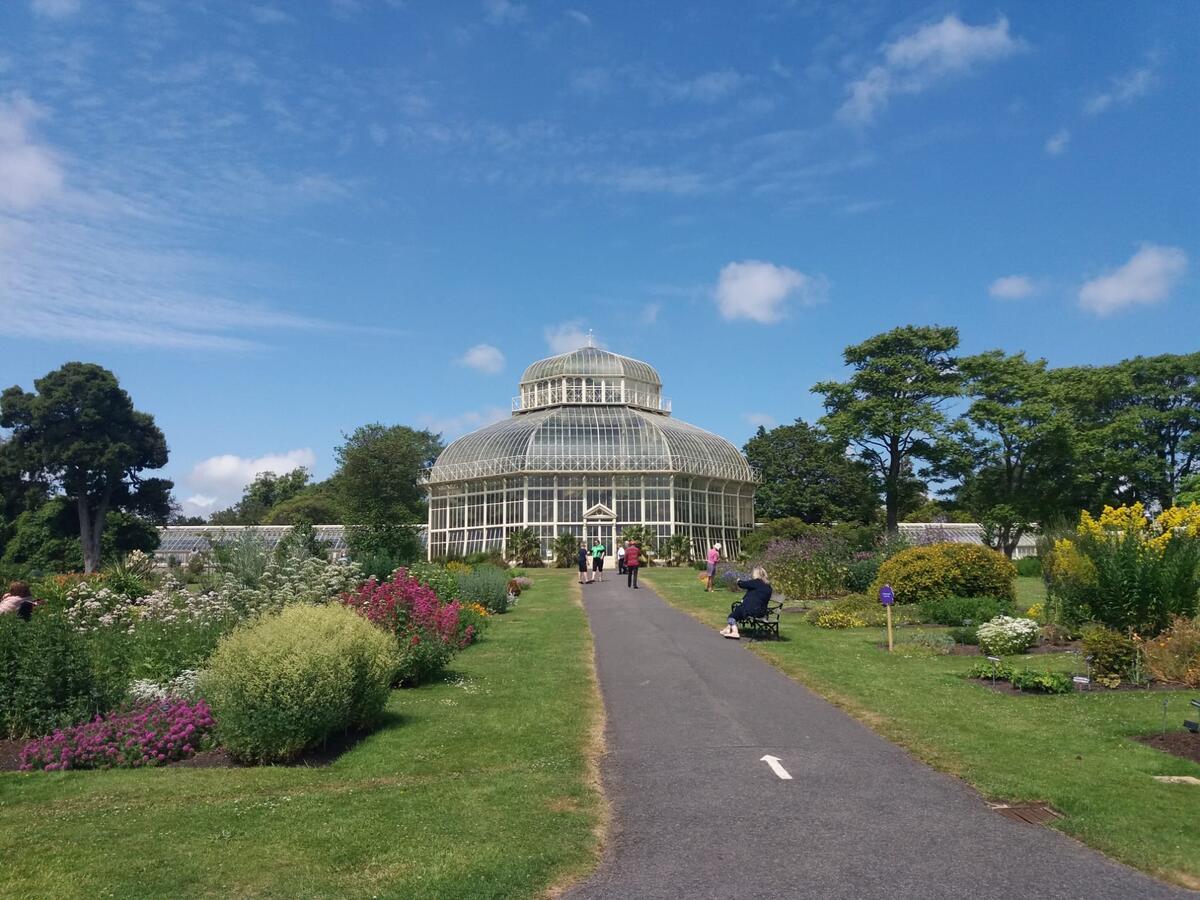
Victorian ironmaster Richard Turner left an indelible mark with the Curvilinear Range (1848) and the Great Palm House (1862). After a wooden predecessor collapsed in 1883, Turner’s iron‑and‑glass construction replaced it, creating the majestic Palm House that still dominates the southern landscape. The glasshouses have undergone extensive restoration, earning a Europa Nostra award for conservation excellence. The site also hosted the first identification of the Phytophthora infection that caused the Great Famine, underscoring its long‑standing role in plant pathology.
Over the past 25 years a major renewal programme has refreshed the glasshouses, added a modern Visitor Centre and expanded the plant collections.
What to See & Do
The Glasshouses
- Great Palm House – A 65‑foot‑high iron marvel housing tropical palms, orchids and a spectacular collection of subtropical foliage. The interior climate stays warm year‑round, making it a perfect rainy‑day destination.
- Curvilinear Range – Designed by Turner, this range showcases temperate and alpine species in a series of interlinked bays. Its elegant iron arches are a study in Victorian engineering.
- Fern House (1965) – Completed in 1965, this glasshouse focuses on ferns and shade‑loving plants, complementing the older structures.
- Aquatic, Cactus and other specialised houses – Currently under restoration, these houses once displayed giant Amazonian water lilies, desert succulents and other exotic collections. Keep an eye on the official website for reopening dates.
- Five glasshouses in total – The Botanic Gardens now operate five glasshouses, each offering a distinct climate and plant theme.
Outdoor Gardens
- Rose Garden – A fragrant promenade of heritage and modern rose cultivars, punctuated by a military‑style sundial.
- Rockery – A colourful, chaotic assemblage of alpine and rock‑garden plants that has delighted visitors since the late 1880s.
- Sensory Garden – Opened by former Taoiseach Bertie Ahern in 2003, this garden invites touch, sound, taste and smell, offering an inclusive experience for all ages.
- Bog Garden, Arboretum and Herbaceous Border – Each area demonstrates a different habitat, from peat‑land flora to mature trees from around the globe.
- Bandstand (1894) – An elegant shelter built in 1894, originally intended for small musical performances; today it provides a shaded resting spot.
- Sundials – A classic sundial stands in front of the Palm House, while a modern military‑style sundial watches over the Rose Garden.
Cultural Highlights
- Twelve Portraits – In the Visitor Centre, portraits by Anna O’Leary honour botanists such as Carl Linnaeus, Gregor Mendel and Charles Darwin, alongside Irish figures like Robert Lloyd Praeger and Sir Frederick Moore.
- National Herbarium – Holds over 20 000 dried plant specimens, a treasure trove for researchers.
- Garden Tearoom – Situated beside the Visitor Centre, the Tearoom offers tea, coffee, cakes and hot lunches with panoramic garden views.
Experiences
Guided tours run daily at 11:30 am and 3:00 pm; advance booking is recommended, especially in peak season. The tours cost €5 per person, but are free on Sundays (12 pm and 2:30 pm). Group tours can be pre‑booked for €2 per person. For self‑guided exploration, download the free audio tours (yellow, red, green) from the Guidigo app – each colour focuses on a different theme, from history to river ecology to glasshouse flora.
Conservation and Research
The Botanic Gardens play a pivotal role in plant conservation. The National Herbarium’s collection of over 20 000 dried specimens supports taxonomic research, while the on‑site DNA research laboratory works on safeguarding endangered species. Many plants in the gardens are listed as extinct in the wild; the Gardens act as a living ark for these species. Conservation projects are regularly highlighted in the Visitor Centre exhibitions.
Learning, Workshops & Exhibitions
- Film & Audio – A short introductory film about the Gardens is available for continuous viewing in the Visitor Centre. The free Guidigo audio tours can be downloaded on‑site.
- Workshops – Throughout the year the Gardens host practical workshops on topics such as seed‑saving, sustainable gardening and botanical illustration. Sessions are open to beginners and experienced gardeners alike.
- Educational Programs – Schools and university groups can arrange tailored tours and hands‑on activities. The Gardens also run a summer programme for children, focusing on sensory exploration and biodiversity.
- Group Tours – Pre‑booked group tours are available for €2 per person, with a dedicated guide and optional hands‑on activities.
Visitor Centre and Facilities
Opened in the early 2000s, the modern Visitor Centre houses a café, a fine restaurant, lecture facilities and a small shop. Free Wi‑Fi, baby‑changing facilities and wheelchair‑accessible toilets are provided. A lift connects the ground floor to the upper levels of the Palm House. Assistance dogs are permitted; other pets are not allowed. Secure bike racks sit beside the Visitor Centre.
Practical Information
Opening Hours
| Season | Weekdays | Weekends & Public Holidays |
|---|---|---|
| Summer (Mar – Oct) | 09:00 – 17:00 | 10:00 – 18:00 |
| Winter (Nov – Feb) | 10:00 – 16:30 | 10:00 – 16:30 |
| Closed | Christmas Day |
Note: Some sources list winter weekdays as 09:00 – 16:30; the table reflects the most commonly published times.
Getting There
- By Bus – Routes 4, 9, 83 and 155 stop at Botanic Road, a short walk from the main entrance.
- By DART – Drumcondra station is a 20‑minute walk.
- By Car – Limited on‑site parking is available on Botanic Road. The first two hours cost €1 per hour; thereafter €2 per hour. Arriving early improves the chance of a space.
- By Bike – Secure bike racks sit beside the Visitor Centre.
Facilities
The gardens provide a visitor centre, café, free Wi‑Fi, baby‑changing facilities, a bookshop, and wheelchair‑accessible toilets. A lift connects the ground floor to the upper levels of the Palm House. Assistance dogs are permitted; other pets are not allowed. Bikes, scooters and other personal transport are prohibited on the footpaths.
Accessibility
A detailed accessibility map can be downloaded from the official website. While most paths are level, a few sections have steep gradients, so visitors with limited mobility should consult the map before venturing into the arboretum or rockery.
Contact & Further Details
For specific enquiries, call +353 1 804 0300 or email the library at LibraryNBG@opw.ie. The official site (https://www.botanicgardens.ie/) remains the correct URL for the latest information.
Events & Exhibitions
The Botanic Gardens host a rotating programme of exhibitions, seasonal displays and hands‑on workshops throughout the year. Highlights often include:
- Spring Floral Exhibition – Showcasing early‑season bulbs and native wildflowers.
- Summer Tropical Showcase – Inside the Palm House, featuring rare orchids and exotic palms.
- Autumn Harvest Festival – Demonstrations on seed‑saving and traditional Irish garden crops.
- Winter Lights – Subtle illumination of the glasshouses and pathways for evening visits.
All events are listed on the Gardens’ website and at the Visitor Centre information desk. Admission to exhibitions is free, though some specialised workshops may carry a modest fee.
Nearby Attractions
If you have time after exploring the Botanic Gardens, consider a short drive or bus ride to Ardgillan Castle – History, Gardens & Family Fun Near Dublin. The castle’s extensive grounds, playground and coastal walks complement a day spent among Dublin’s botanical treasures. Within a few kilometres lie Glasnevin Cemetery, the historic resting place of many notable Irish figures, and Phoenix Park, one of Europe’s largest urban parks, offering additional walking routes, a zoo and historic monuments.
The National Botanic Gardens blend scientific heritage with natural beauty, offering a free, family‑friendly escape that feels worlds away from the city’s traffic. With its award‑winning glasshouses, diverse themed gardens, active conservation work and a programme of workshops and exhibitions, it remains a highlight of any Dublin itinerary.