
Overview
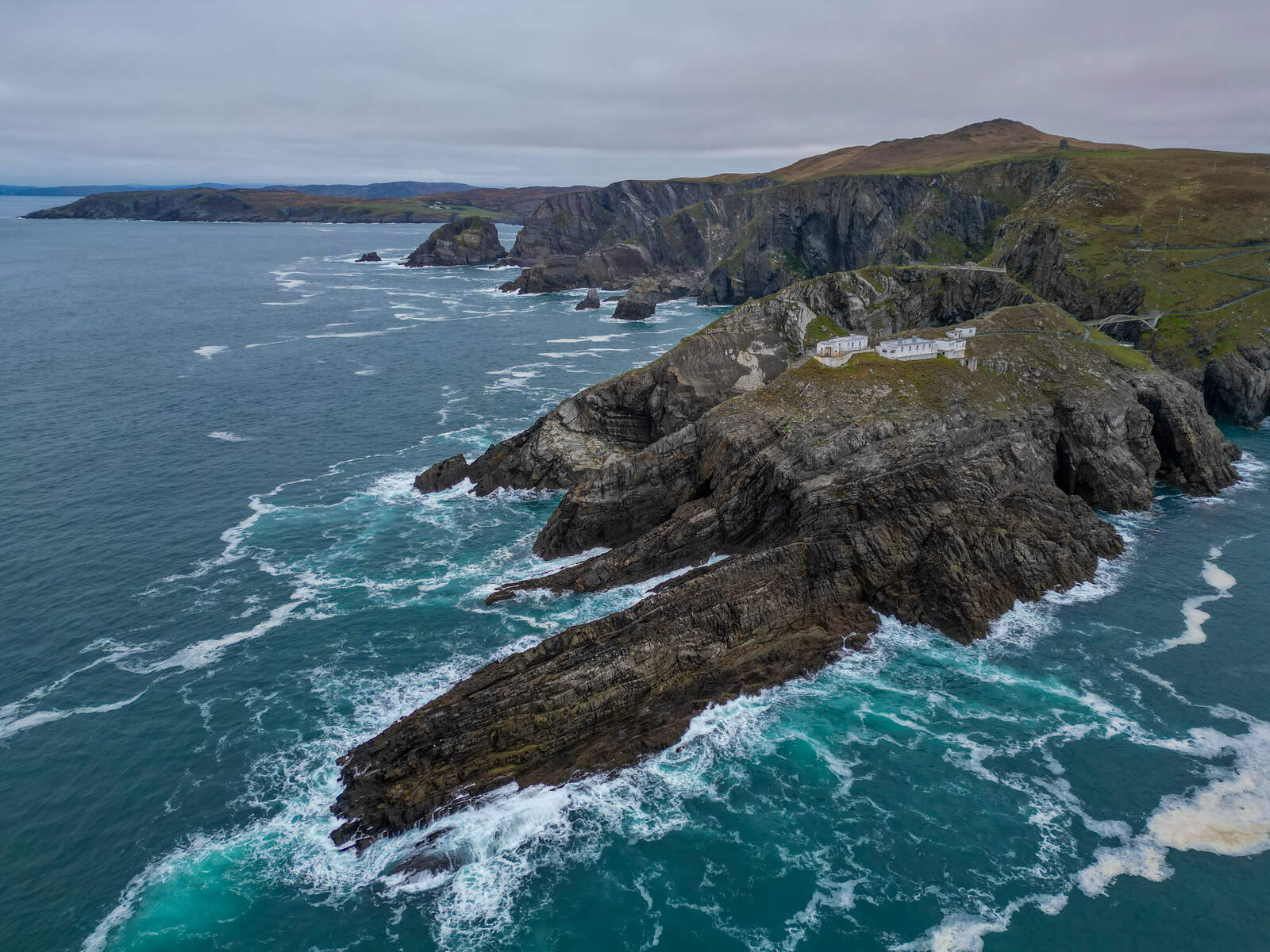
Dunlough Castle, also known as Three Castle Head, crowns the northern tip of the Mizen Peninsula in County Cork. Built in 1207 by Donagh O’Mahony, the castle consists of three modest rectangular towers linked by a low defensive wall that once stretched from the sheer Atlantic cliffs to a man‑made lake. The site commands an unrivalled panorama of the wild Atlantic, a deep inland lake, and cliffs that plunge some 120 metres to Dunmanus Bay. Its isolation – the only access is a marked footpath across private farmland – gives the ruin an almost otherworldly feel, as if time has paused on the edge of the continent.
History
The O’Mahony clan, princes of the ancient kingdom of Eóganacht Raithlind, retreated westward after the Norman advance of the late 12th century. In 1207 Donagh “the Migrator” O’Mahony erected Dunlough as a defensive bastion at the farthest reaches of their territory. For four centuries the O’Mahonys lived, fished and farmed here, never suffering a recorded siege. In 1627 the castle was confiscated by the British Crown and has remained largely untouched by modern restoration – its dry‑stone masonry still bears the marks of centuries of wind and salt.
Architecturally, Dunlough is unusual for its use of dry‑stone construction, a technique more common in prehistoric Irish sites than in later medieval forts. Each of the three towers displays a distinct design: the eastern tower likely served as the gatehouse and retains a visible spiral staircase; the western tower, the largest, was probably the main residence and features linear staircases; the central tower combines both stair types and would have acted as a lookout and storage hub. A characteristic second‑storey door, accessed historically by a removable ladder, can still be seen on the western keep. The connecting wall, originally over a hundred feet long and four‑metres high, now lies in partial ruin but still hints at the formidable barrier it once formed.
The ruin is listed as a National Monument of Ireland, affording it legal protection under the National Monuments Service. Local folklore adds a layer of mystery. The ruins are said to be haunted by the “White Lady,” a spectral figure believed to foretell death, and some legends speak of a giant who built the castle and whose ghost still roams the cliffs.
What to See & Do
- Three towers and the wall – Wander among the three stone keeps, noting the differing staircases and the remnants of the defensive wall that once linked them. The western tower offers the best view of the Atlantic and the lake below.
- The lake and dam – At the eastern shore, a low stone dam still holds back the lake’s water, creating a reflective pool that mirrors the cliffs.
- Cliff‑edge vistas – A narrow footpath on the western side leads to the edge of the cliffs, where you can gaze down 120 metres to the sea‑filled Dunmanus Bay.
- Wildlife – The headland is a good spot for bird‑watching; gulls, razorbills and occasional peregrine falcons can be seen soaring above the cliffs.
- Ghostly legends – Keep an eye out for the “White Lady” and listen for the wind that has inspired centuries of folklore.
- Dog‑friendly – Well‑behaved dogs on a leash are permitted on the footpath, making it a pleasant walk for pet owners.
- Nearby attractions – After exploring the castle, consider a short drive to Barleycove Beach, Mizen Head, or the Sheep’s Head Way for additional coastal scenery.
Visiting Tips
- Parking & honesty box – A small car park at the trailhead offers free parking; an honesty box asks for a €3 contribution per person to help maintain the path and respect the private landowner.
- Footpath – The marked trail is about 2.3 km (1.4 mi) round‑trip and takes roughly 55 minutes at a steady pace. The route is steep, uneven and can become boggy after rain, so wear sturdy, waterproof footwear.
- Weather – The site is exposed to Atlantic winds; bring a windproof jacket and layers even in summer.
- Safety – The cliffs are unprotected and can be slippery in mist or fog. If visibility is poor, postpone the walk.
- Facilities – No restrooms, café or visitor centre are on site. The nearest amenities are in the village of Goleen, about a 10‑minute drive away.
- Accessibility – The approach involves a steep, uneven walk; it is not wheelchair‑friendly.
- Photography – Drones are prohibited; hand‑held cameras are fine.
Practical Information
Dunlough Castle is accessed from the south via a marked trail that begins at a small car park equipped with an honesty box. The walk is steep and includes uneven, occasionally boggy sections, especially after rain. Good, sturdy footwear is essential, and a moderate level of fitness is recommended. The route is unguarded; during mist or fog the cliffs become hazardous, so visitors are advised to postpone the walk in poor visibility. Drones are prohibited, and visitors must stay on the marked path to protect both the fragile masonry and the surrounding farmland.
There are no formal opening hours or admission fees – the site is free to explore year‑round. Facilities are minimal; the car park provides basic parking, but there are no restrooms or a visitor centre on site. Donations are welcomed at the honesty box to support ongoing conservation of the dry‑stone structures.
Getting there – The nearest village is Goleen, about a 10‑minute drive from the car park. From Cork City, follow the N71 west to the Mizen Peninsula, then take the R595 to the turn‑off for Dunlough. Public transport options are limited; a car or a hired vehicle is the most convenient way to reach the trailhead.
Safety note – The cliffs are unprotected, and the terrain can be slippery. While the site is open to all, the combination of steep climbs and uneven ground makes it unsuitable for wheelchair users or those with limited mobility.
Coordinates: 51.482617 N, 9.829506 W