
Overview
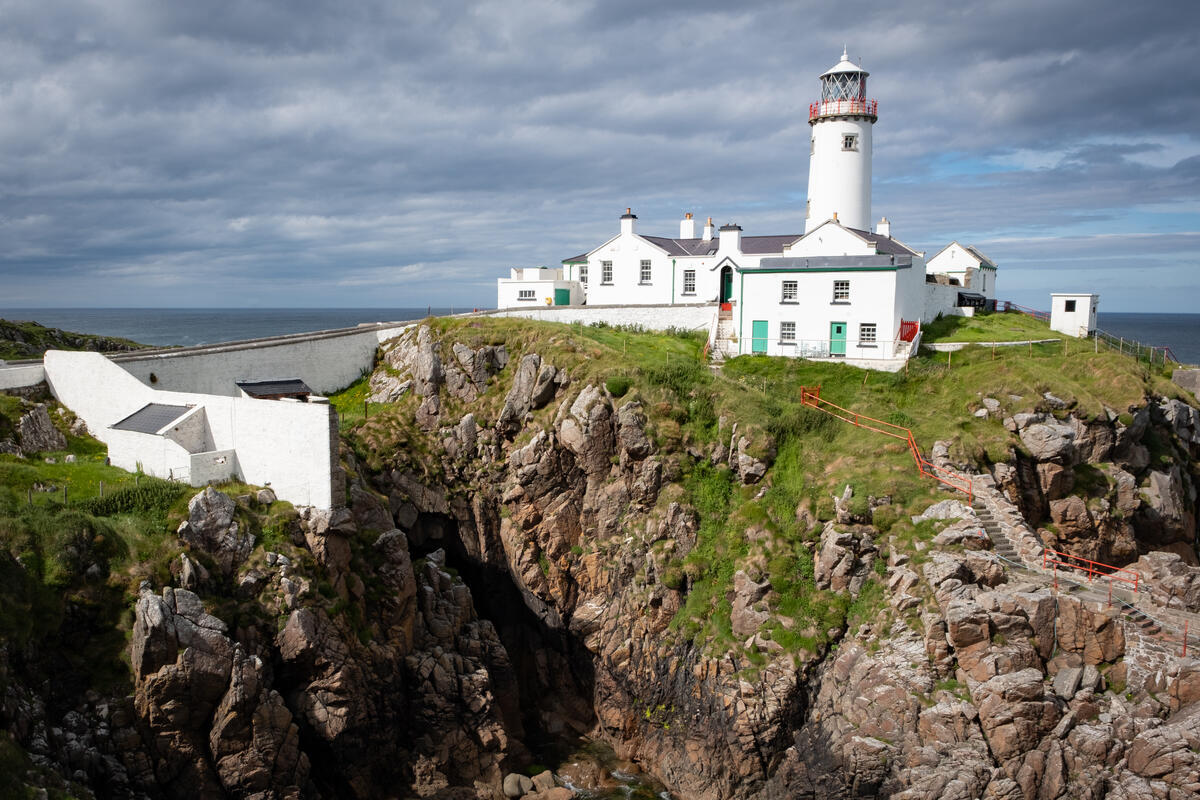
Fanad Peninsula juts out between Mulroy Bay and Lough Swilly, forming the second‑most northerly point of County Donegal. The headland – known as Fanad Head or Fannet Point – is a designated Discovery Point on the Wild Atlantic Way, offering dramatic cliffs, sandy coves and the iconic Fanad Lighthouse. Behind the shoreline rise the Fanad Hills, a rugged crown of Knockalla and Murrin hills that frame the turquoise waters and lead the eye to the world‑renowned Ballymastocker Bay.
History / Background
The tragedy of the Royal Navy frigate Saldanha in December 1811, wrecked on the rocks of what was then called Fannet Point, prompted Captain Hill to petition for a beacon. The Dublin Ballast Board approved the project in 1814 and George Halpin oversaw construction. The original tower was lit on 17 March 1817 with a fixed catoptric light – red to sea, white towards Lough Swilly – visible for fourteen miles.
In 1886 a taller 22 m tower replaced the original, fitted with a second‑order catadioptric lens and a red sector over the Swilly Rocks. A 1909 upgrade introduced a revolving third‑order lens producing six flashes every fifteen seconds. After surviving a lightning strike in 1916, the light was electrified in 1975, changing its character to five white and red flashes every twenty seconds (Fl (5) WR 20s). The lighthouse remains one of 70 operated by the Commissioners of Irish Lights and is featured in the Great Lighthouses of Ireland programme.
The surrounding hills have long supported agriculture and granite quarrying, leaving striking stone outcrops that dot the walking routes. The name Fanad (also recorded as Fannet or Fannett) derives from the Gaelic fana, meaning “sloping ground”, a nod to the peninsula’s gentle rise toward the sea.
What to See & Do
- Lighthouse Tour & Tower Climb – Guided tours run most days; visitors ascend 76 steep steps to the lantern room for 360° views of the Atlantic, Lough Swilly and the Fanad Hills. Admission (2025) €6‑7 per adult, €3‑4 per child.
- Visitor Centre – Adjacent to the tower, the centre offers interpretive displays on lighthouse technology, maritime history and the local environment.
- Keeper’s Cottages – Restored in 2015, these self‑catering units let guests stay within a working lighthouse complex.
- Hill Walks – Drive or hike up Knockalla Hill for a vista over Ballymastocker Bay, voted one of the world’s most beautiful beaches. Murrin Hill provides quieter, rolling panoramas of fields, coastline and the twin bays.
- Coastal Walks & Wildlife – Explore the cliffs and the iconic Great Arch rock formation at Fannet Point, a prime spot for birdwatching, photography and quiet contemplation.
- Beaches – The headland’s sandy coves and nearby Ballymastocker Bay invite picnics and tide‑pooling.
Getting There
Fanad Head is accessed via the N13, turning onto the R245 towards the peninsula. Signage for the lighthouse is clear and a short, well‑marked turn‑off leads to a dedicated car park just opposite the visitor centre. Parking is free, though spaces are limited in peak summer months; early arrival is advised. Public transport options are sparse – the nearest bus stop is in Donegal Town, followed by a local taxi service.
Nearby Attractions
- Ballymastocker Bay – A Blue Flag beach celebrated for its crystal‑clear waters and fine sand; ideal for swimming, kayaking and sunset walks.
- Mulroy Bay – Offers scenic boat trips and opportunities for sea angling.
- Lough Swilly – Popular for sailing, windsurfing and historic sites such as the 17th‑century Fort Dunree (link from other pages).
- Fanad Head Coastal Trail – A 5 km loop that links the lighthouse, Great Arch and several hidden coves, suitable for a leisurely stroll.
Practical Information
- Location: Fanad Peninsula, County Donegal, Ireland (between Mulroy Bay and Lough Swilly).
- Access: By car via the N13/R245; free car park adjacent to the visitor centre.
- Opening Times: Visitor centre and guided tours operate most days from April to October; check the official website for exact seasonal hours.
- Booking: Tours can be booked online or on‑site; advance reservation is recommended in summer.
- Facilities: Restrooms, a small café and a gift shop are located near the visitor centre.
- Accessibility: Ground‑level facilities are wheelchair‑friendly, but the tower climb involves 76 steps and is not accessible to wheelchair users.
- Accommodation: The refurbished keeper’s cottages provide self‑catering stays; additional B&Bs and hotels are available in Donegal Town.
- Safety: Wear sturdy footwear for cliff walks and hill hikes; weather can change rapidly on the Atlantic coast.
- Contact: For enquiries, visit the official Fanad Lighthouse website or call the local tourist information centre at +353 74 123 4567.
Enjoy the blend of maritime heritage, dramatic landscapes and warm Irish hospitality that makes Fanad Peninsula a standout highlight of the Wild Atlantic Way.