

Overview
Lough Veagh (Irish: Loch Ghleann Bheatha) sits in the remote north-west of County Donegal, roughly 30 km north-west of Letterkenny. Stretching about 5 km long and 1 km wide, the lake is confined within a narrow valley where sheer granite cliffs rise to 300 m on either side. The water acts as a natural mirror, reflecting the sky and the rugged Derryveagh and Glendowan mountain ranges that surround it. A string of small islands clusters near the northern end, adding texture to the waterscape. The lake is fed by the Owenbeagh River at its southern tip and drains northwards via the Owencarrow River, which connects it to Glen Lough. This isolated, basin-like setting makes it a favoured stop for photographers, walkers, and anyone looking to step away from the coast into Donegal’s wild interior.
A Landscape Forged by History
The name Gleann Bheatha translates to “valley of life,” though local tradition also links it to “valley of the birches.” Long before it became a protected wilderness, the lake served as a strategic stronghold. The Annals of the Four Masters record that around 1540, sons of the Ó Domnaill clan held a crannog (a fortified lake dwelling) here, using it as a base for local campaigns. The exact site of the crannog has been lost to time, but the lake’s role as a natural fortress remains clear.
The landscape changed dramatically in the late 19th century when Captain John George Adair arrived from the United States. Having made his fortune in American land speculation, Adair purchased vast tracts of Donegal land and set about building a hunting lodge on the western shore between 1870 and 1873. His ambition was to create an estate that would surpass Queen Victoria’s Balmoral. To achieve his vision of unbroken mountain views, Adair evicted 224 local tenants from their homes shortly after the Great Famine, a decision that left a lasting mark on local memory. The estate passed to American philanthropist Henry Plumer McIlhenny in 1937, who hosted Hollywood guests like Marilyn Monroe and Greta Garbo. In 1981, McIlhenny gifted the castle, gardens, and surrounding 170 sq km of land to the Irish nation, establishing Ireland’s largest national park.
What to See & Do
Water-edge walks & mountain trails
A stroll along the lakeshore offers uninterrupted views of the granite cliffs and calm water. The park’s trail network is well sign-posted and caters to different fitness levels. The Lough Inshagh Walk is a flat 2 km loop along the northern shore, suitable for families and wheelchair users. For more elevation, the Viewpoint Trail climbs 3.5 km to a granite outcrop with sweeping panoramas over the lake and Derryveagh range. The Derrylahan Nature Trail provides a gentler 1 km boardwalk through native woodland, while the Garden Trail winds through the castle’s formal grounds. All routes are marked with the orange Glenveagh logo.
Wildlife & angling
The lake supports a healthy population of brown trout, sea trout, Arctic char, salmon, minnow, and the critically endangered European eel. Anglers must purchase a permit from the National Parks & Wildlife Service, available at the Visitor Centre. Above the water, birdwatchers frequently spot the migrating red-throated diver. The park is also the site of Ireland’s golden eagle reintroduction programme, launched in 2000 after the species had been absent for centuries. Patient observers can often see the eagles circling the thermal currents above the cliffs. On the hillsides, Ireland’s largest herd of red deer grazes year-round, particularly active at dawn and dusk.
Glenveagh Castle & Gardens
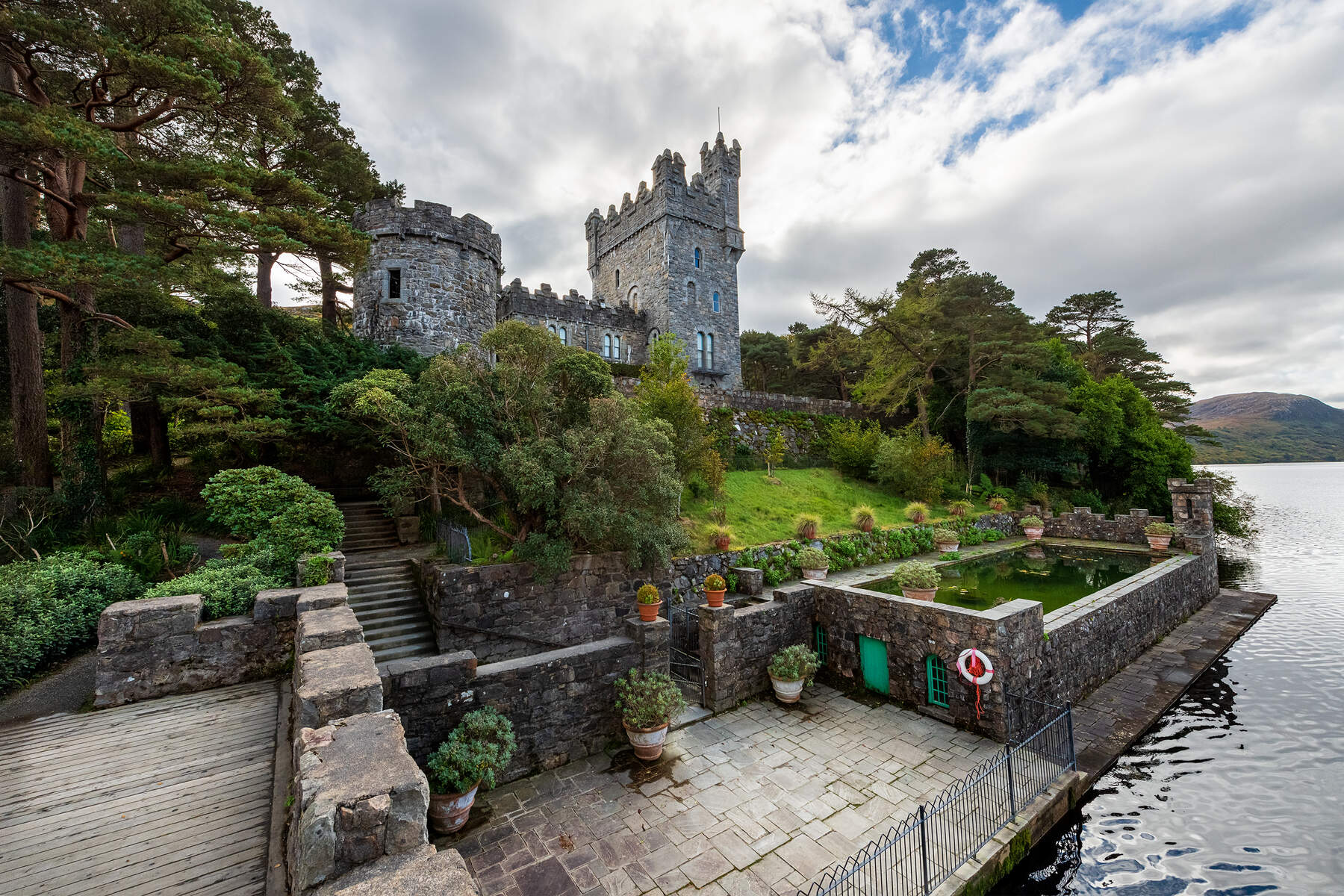 Standing on the western shore, Glenveagh Castle is a four-storey Scottish Baronial mansion surrounded by a network of informal gardens. The plantings feature species sourced from Chile, Madeira, and Tasmania, all protected by dense windbreaks of pine and ornamental rhododendrons. The Visitor Centre, located nearby, hosts interactive displays on the park’s ecology and history, plus a fully accessible audio-visual presentation. Self-guided castle tours run Tuesday to Sunday, with limited spaces in winter and peak summer months.
Seasonal Highlights
The park’s calendar brings structured events alongside the natural rhythms of the landscape:
- Le Chéile don Dúlra Biodiversity Festival (usually early April): Guided walks, expert talks, and family activities focused on local flora and fauna.
- Easter Sunday Music & Dancing: Traditional Irish sessions held in the castle grounds.
- 5 km Park Run (June): A community event raising funds for Acquired Brain Injury Ireland.
- Winter Bird-watching Walks (November–February): Guided sessions targeting winter visitors like the red-throated diver and peregrine falcon.
Dates and booking requirements change annually, so check the official park website before planning your visit.
Practical Information
Entry to Glenveagh National Park is free, and the grounds are open from dawn to dusk throughout the year. Charges apply only for specific services like the castle tour, tea-room, and shuttle bus.
- Visitor Centre: Open 09:15–17:30 daily (closed 24 Dec–2 Jan). Features wheelchair-accessible routes and an audio-visual show.
- Castle Tours: Self-guided, running Tue–Sun. Mar–Oct: 09:15–17:15; Nov–Feb: 10:00–17:15. No advance booking required, but winter slots fill quickly.
- Shuttle Bus: Connects the Visitor Centre and Castle Gardens. €3 single / €5 return. Year-round service; last bus returns at 16:45.
- Heritage Card: Free for Irish residents. Covers unlimited shuttle travel and castle entry. Available at the Visitor Centre. Learn more about the Heritage Card.
- Parking & Transport: Free car park at the main entrance (R255). Arrive early in summer to secure a spot. Bus 271 (Burtonport–Letterkenny) stops at the park flagpole.
- Facilities: Toilets, baby-changing, and a café (Nellie’s, seasonal) are available. The castle tea-room operates 10:00–17:00 year-round.
- Accessibility: The lakeside path and Garden Trail are wheelchair-friendly. Steeper mountain routes and some castle interiors have limited access.
Nearby Attractions
Lough Veagh sits at the centre of Donegal’s most rugged terrain, with several notable walks and landmarks within a short drive:
- Aghla Beg: Part of the Seven Sisters range, this 564 m peak lies 6 km south-east. A solid half-day hike with ridge-line views. [/aghla-beg/]
- Muckish Mountain: A distinctive flat-topped peak 12 km north-west, drawing experienced walkers for its challenging ascent and coastal outlook.
- Duntally Wood: A 15-hectare native woodland reserve 10 km east, featuring marked trails and a wild-play area for children.
- Poisoned Glen: A dramatic, folklore-rich valley near Dunlewey, offering moody scenery and local legend.
For a broader look at protected landscapes, explore the guide to Ireland’s National Parks. Plan your arrival before midday in peak season to avoid shuttle queues, and keep binoculars handy if you time your lakeside walk for late afternoon when the golden eagles typically begin their evening hunting circuits.