
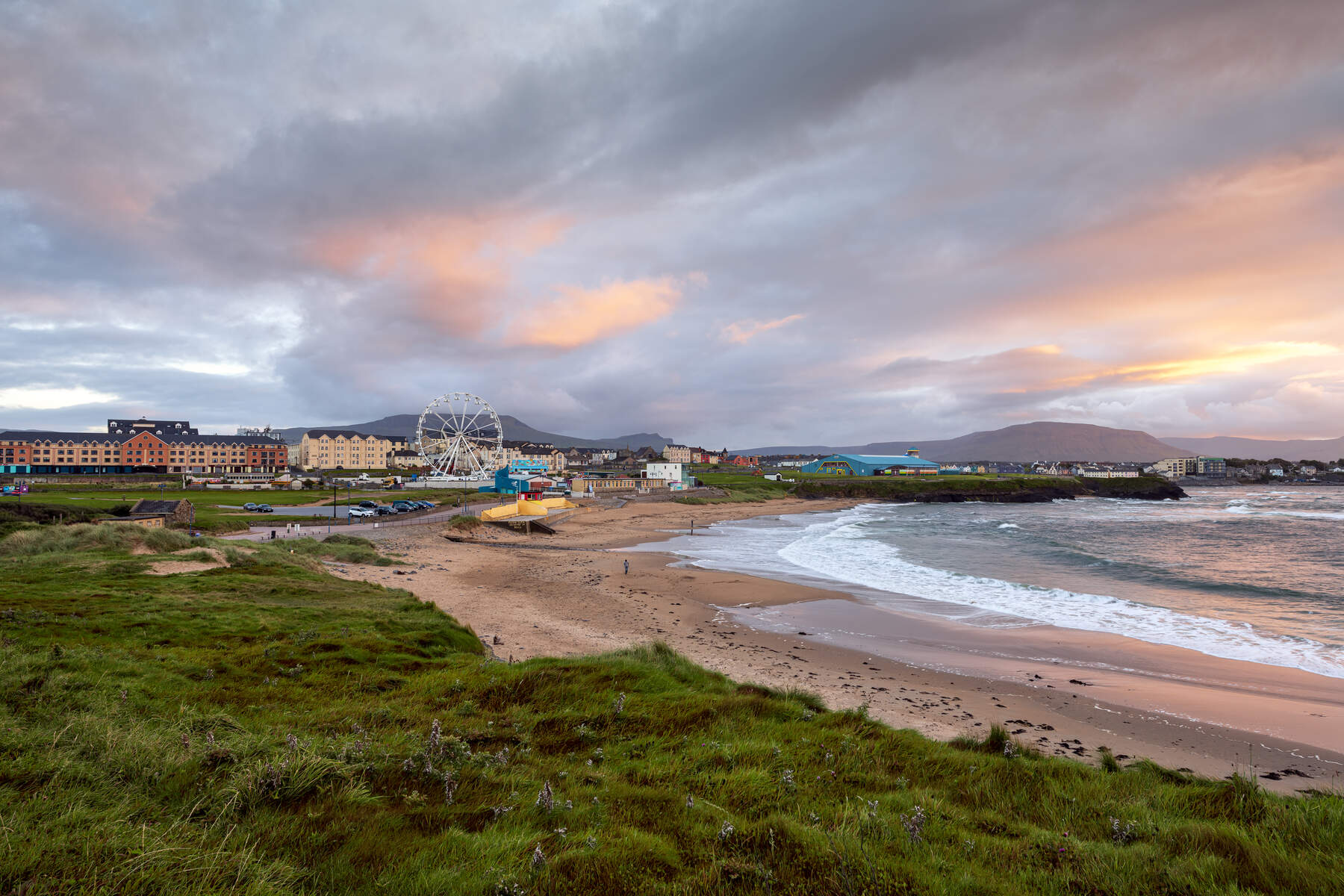
Overview
Malin Head sits at the very tip of the Inishowen Peninsula in County Donegal, marking the northernmost point of mainland Ireland (latitude 55.38° N). The headland is the start (or finish) of the Wild Atlantic Way and offers a dramatic mix of sea‑battered cliffs, sweeping Atlantic vistas and a surprisingly rich tapestry of history, geology and wildlife. From the iconic Banba’s Crown – locally known as “The Tower” – to the raised beach of Ballyhillin, the area feels both remote and welcoming, with a small coffee‑truck, a historic pub and several well‑signposted walking routes.
History & Background
The first recorded reference to the headland comes from Ptolemy’s 2nd‑century geography, which called a point “Boreion” (the northern). In modern times the most visible reminder of its strategic past is the 1805 stone tower built by the British Admiralty to guard against a possible French invasion during the Napoleonic Wars. The tower later became a Lloyds Signal Station, linking America and Europe with telegraph messages. A second, smaller signal tower – Lloyds Signal Tower – was added in the early 20th century, and a Marconi radio station was erected in 1910, making Malin Head a hub of early wireless communication.
During World War II (the Irish “Emergency”) the site hosted two radio‑direction‑finder stations used by Allied forces to monitor U‑boat activity. A large stone “EIRE 80” ground marker was laid nearby to signal neutral Irish airspace to over‑flying aircraft. The weather station, established in 1885 and rebuilt by Met Éireann in 1955, still records hourly data that feed the BBC Shipping Forecast.
What to See & Do
| Feature | Why it matters |
|---|---|
| Banba’s Crown (The Tower) | 1805‑era watchtower, now a striking silhouette at the northern tip; a perfect photo‑op and a reminder of the headland’s defensive role. |
| Ballyhillin Raised Beach | Internationally important geological site showing sea‑level change since the last Ice Age; also a source of semi‑precious stones such as chalcedony and agate. |
| Hell’s Hole & Devil’s Bridge | A 250‑ft long, 8‑ft wide sea‑cave where the tide rushes through with audible force, and a natural arch that frames the Atlantic. |
| Inishtrahull Island & Lighthouse | Visible from Banba’s Crown; the island’s lighthouse flashes every 30 seconds and is a favourite spot for birdwatchers. |
| Wildlife Watching | Autumn migrations bring gannets, shearwaters, skuas and auks; rarer sightings have included black‑browed albatrosses. The waters host bottlenose dolphins, basking sharks and occasional porpoises. |
| Northern Lights | On clear, dark evenings the Aurora Borealis can be seen dancing over the Atlantic – a rare treat for visitors. |
| Star Wars: The Last Jedi | The 2016 filming left the Millennium Falcon replica on the cliffs; a dedicated Star Wars walking tour explains the on‑location magic. |
| Caffe Banba | Ireland’s most northerly coffee shop, perched near the tower; open Easter‑September, serving coffee and baked treats. |
| Farren’s Bar | The most northerly pub in Ireland, famous for welcoming Mark Hamill during the Star Wars shoot. |
| Fishing Pier | A sturdy pier offers opportunities for catching coalfish, pollack, wrasse, dab, conger eel, dogfish and mackerel. |
| Wreck Diving | The surrounding waters contain the highest concentration of sunken liners and U‑boat wrecks in Europe, attracting experienced divers. |
Walking the Malin Head Loop
The most popular route is the 2.5 km “Malin Head Walk”. Starting at the car‑park, the trail leads to Lloyds Signal Tower, then on to Banba’s Crown, the EIRE 80 sign, Hell’s Hole, and finally the panoramic viewpoint that looks out over Tor Beg Rock, Scheildren rock formations and the distant Scottish hills. The walk is moderate in difficulty and takes about an hour, making it suitable for families and casual hikers.
Practical Information
| Item | Details |
|---|---|
| Opening hours | Open daily, all day |
| Admission | Free |
| Parking | A modest car‑park is located at Ardmalin; it is quiet outside the summer months but can fill up during peak season. |
| Toilets | Public toilets are available in the car‑park area. |
| Coffee & Refreshments | Caffe Banba (seasonal) and Farren’s Bar (open year‑round) are within walking distance of the tower. |
| Contact | Phone: +353 749 363 451 |
| Website | Donegal County Council booklet (PDF) |
| Latitude / Longitude | 55.38 N, ‑7.37 W |
Getting There
Malin Head is about 15 km north of the village of Malin and a 30‑minute drive from Ballyliffen. The most convenient approach is via the coastal road that runs along the north side of Trawbreaga Bay, passing the large sand dunes of the area. Visitors arriving from Dublin, Belfast or Derry can join the Wild Atlantic Way route and follow the signs for the Inishowen Peninsula. The nearest airports are Donegal Airport (near Carrickfinn) and Derry~Londonderry, both offering short transfer drives.
Seasonal Highlights
- Summer – Longer daylight hours make the full circuit of the headland ideal for photography and bird‑watching.
- Autumn – Migrating seabirds pass overhead; the sky often turns dramatic with storm clouds.
- Winter – The weather station records some of the windiest conditions in Ireland, creating spectacular sea‑spray displays.
- Spring – The coffee‑truck at Caffe Banba re‑opens, and the Northern Lights forecast is frequently favourable.
Accessibility
The main car‑park and the short stretch from the parking area to Banba’s Crown are level and suitable for wheelchair users, though the cliff‑side paths become uneven beyond that point. Visitors requiring assistance are advised to check the latest accessibility updates with the local tourism office.
Malin Head is more than a geographic extreme; it is a living museum of natural forces, human ingenuity and pop‑culture fame. Whether you are tracing the steps of ancient Celtic deities, listening to the wind howl through Hell’s Hole, or imagining yourself on a distant galaxy, the headland offers a uniquely Irish experience that stays with you long after you leave the edge of Europe.