
Overview
Murrisk Millennium Peace Park sits on a gentle rise just north of the R335 road in the village of Murrisk, County Mayo. Spanning five acres, the park was created as part of Ireland’s millennium celebrations and officially opened on 13 July 2001. Its location at the base of the iconic pilgrimage mountain Croagh Patrick provides sweeping panoramas of the Atlantic Ocean, Clew Bay and the surrounding countryside. The landscaping is deliberately restrained, allowing visitors to focus on the park’s two main attractions: the National Famine Memorial – a powerful bronze sculpture known as the “Coffin Ship” – and the historic ruins of Murrisk Abbey, a 15th‑century Augustinian foundation.
The park is also home to a natural spring pond and offers a quiet place for reflection, especially during the annual commemorations on National Famine Memorial Day (16 May). Its proximity to the Croagh Patrick Visitor Centre car park makes it an easy addition to a day of pilgrimage, hiking, or coastal exploration.
History
In 1995 the Irish Government launched a competition for a national famine memorial site. After consultations, Murrisk was selected for its stark western landscape – a region that suffered disproportionately during the famine, with one in four of Connaught’s population perishing. The site was offered by local landowner James Fair in memory of his parents, Seamus and Brigid.
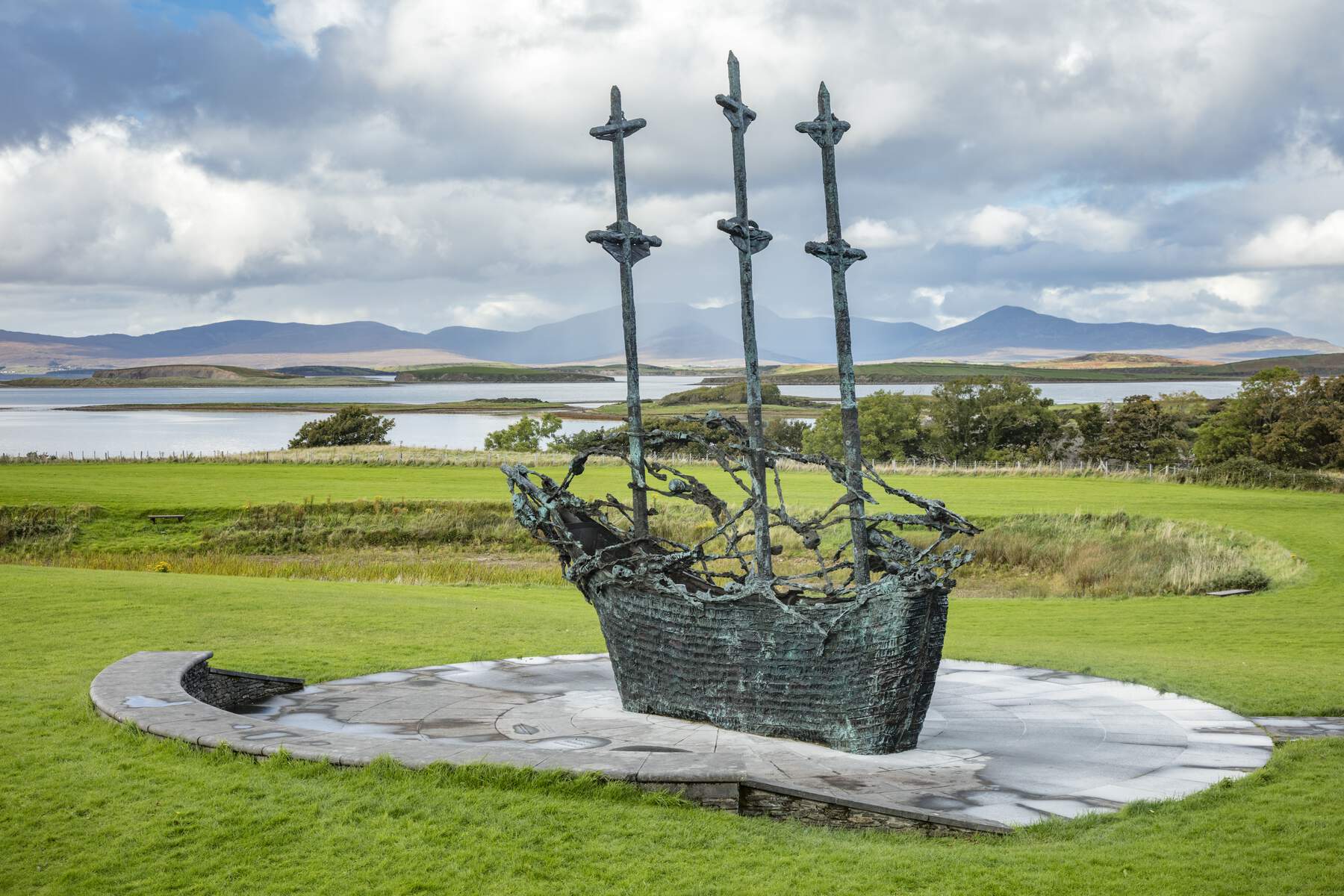
Renowned Irish sculptor John Behan was commissioned to design the memorial. The resulting bronze sculpture, measuring roughly 30 feet long and 25 feet high, depicts a skeletal ship’s hull filled with emaciated figures, symbolising the “coffin ships” that carried desperate emigrants across the Atlantic. The massive casting, the largest ever undertaken in Ireland, was lowered into place by crane in January 1997 and unveiled by President Mary Robinson on 20 July 1997.
Four years later, the surrounding Millennium Peace Park was completed with a £250,000 grant from the National Millennium Committee. Minister Seamus Brennan performed the opening ceremony, describing the park as an “oasis of peace for Reek pilgrims”. The park’s dedication plaque notes its purpose: “dedicated to 2,000 years of Christian worship,” linking the site to the ancient pilgrimage tradition of Croagh Patrick, which dates back over 1,500 years.
Design and Symbolism
The park’s layout was deliberately kept minimal to let the National Famine Memorial dominate the visual field. As the Mayo‑Ireland tourism page notes, the five‑acre site is sympathetically landscaped to act as a fitting backdrop for the bronze “Coffin Ship”.
John Behan has spoken about the sculpture’s intent: the skeletal hull represents the empty, death‑laden ships that carried famine victims, while the emaciated figures clutching at the rigging convey the desperation of those forced to emigrate. The work was commissioned in the mid‑1990s when the famine was still a raw memory for many families; Behan’s own grandfather was born in 1852, the final year of the Great Hunger.
What to See & Do
- National Famine Memorial (The Coffin Ship) – The centerpiece of the park, this bronze sculpture commands a dramatic view over Clew Bay. Its stark imagery invites contemplation of Ireland’s tragic emigration history. The memorial is the focus of candle‑lit vigils on 16 May, but its power is evident year‑round.
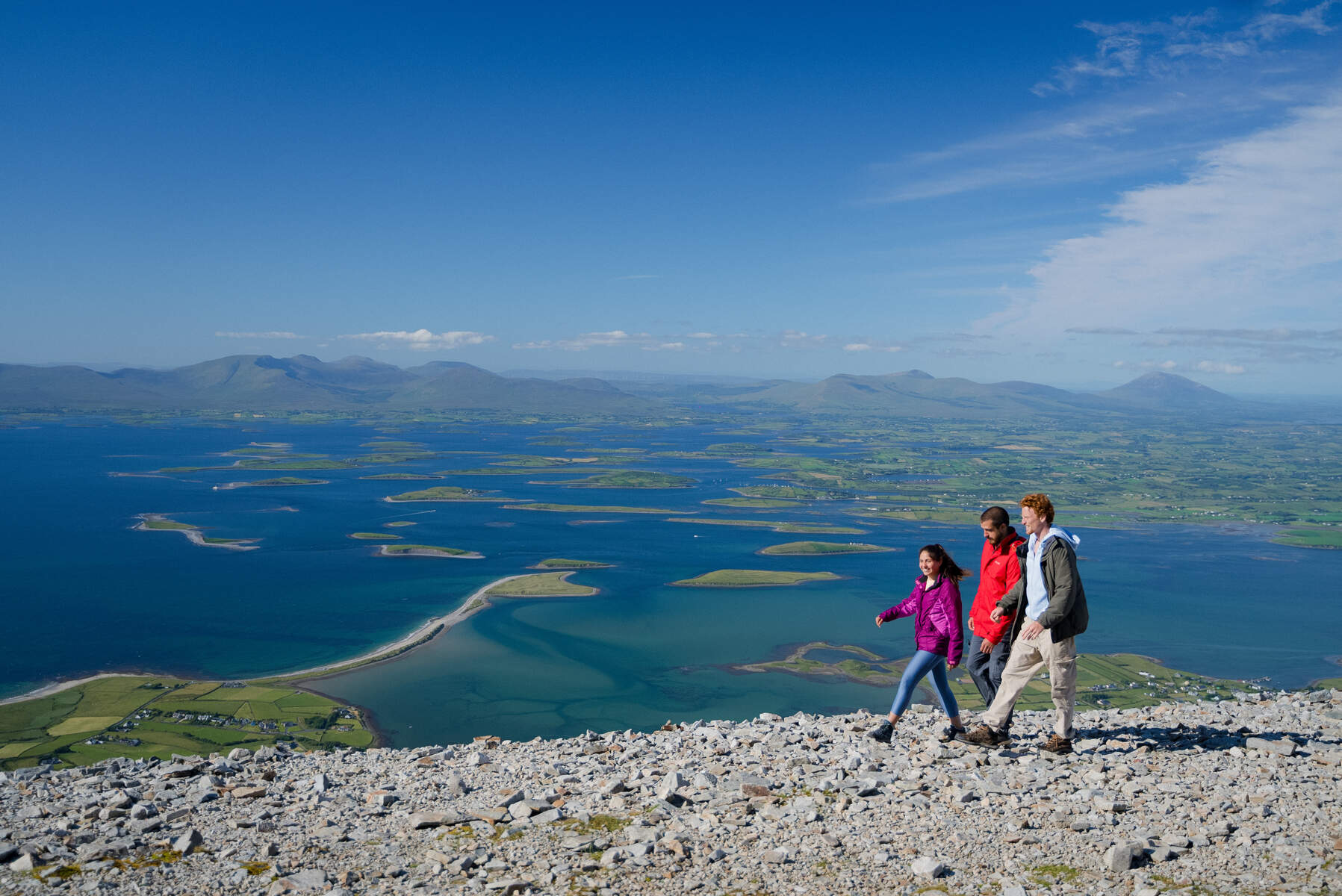
- Views of Croagh Patrick – The park’s open layout frames the mountain’s silhouette, making it an ideal spot for photographers and pilgrims who wish to capture the holy hill before or after their ascent.
- Murrisk Abbey ruins – A short walk eastward leads to the 15th‑century abbey, founded by the O’Malley family. Though largely roofless, the stone walls and surviving arches convey the monastic atmosphere that once dominated the area.
- Natural spring pond – Tucked within the park’s minimal landscaping, the pond adds a soothing water element and attracts local wildlife, especially during the spring months.
- Walking routes – The park serves as a gateway to several coastal and inland trails, including routes that trace the historic Doolough Tragedy landscape and paths leading up to Croagh Patrick itself.
- Pilgrimage rest point – After completing the climb of Croagh Patrick (up to 30,000 pilgrims on the last Sunday of July), many pause here for a moment of quiet before heading back.
Events and Commemorations
- National Famine Memorial Day (16 May) – A state‑led ceremony featuring a minute’s silence, wreath‑laying and candle‑lit vigils. Minister Pat Carey traditionally leads the service, joined by schoolchildren, clergy and community groups.
- 2010 Diplomatic Ceremony – Representatives from the United States (Ambassador Dan Rooney) and Australia (Ambassador Bruce Davis) attended a special commemoration, underscoring the park’s international significance.
- Annual Great Famine Walk – The walk from Doolough to Louisburgh passes close to the park, giving participants a chance to reflect at the memorial before continuing.
- Geocaching – The park is the start point for a two‑stage multi‑cache (GC4HQ60) that guides visitors on a short 300 m walk, offering an interactive way to learn about the Great Famine while exploring the site.
Access & Practical Information
- Location & Parking – The park is set back from the R335 just north of the village centre. It shares the adjacent car park with the Croagh Patrick Visitor Centre, which provides free parking for visitors (subject to space availability).
- Opening hours – The park is open year‑round and free to enter. No formal opening hours are posted; it is accessible at any time, though the visitor centre facilities operate from 9:30 am to 5:30 pm (check the centre for seasonal variations).
- Public transport – Murrisk is reachable by local Bus Éireann services from Westport and Castlebar; the nearest bus stop is the Murrisk village stop, a short walk to the park.
- Facilities – There are no permanent toilets or cafés within the park itself; visitors can use the amenities at the Croagh Patrick Visitor Centre nearby.
- Accessibility – The main pathways are level and suitable for most visitors, but the terrain around the abbey ruins can be uneven.
Nearby Attractions
- Murrisk Abbey – The ruined 15th‑century abbey lies a short walk east of the park.
- Marian Shrine – Located in the village centre, a small shrine dedicated to the Virgin Mary.
- Murrisk Pier – Built by the Congested Districts Board in the 1890s, offering scenic sea views.
- Aughagower – A historic pilgrimage hub just a few kilometres north; explore its ancient churches and holy wells. (Aughagower)
- Croagh Patrick Visitor Centre – Provides maps, interpretive displays and a café for a quick refresh before or after your walk.
In summary, Murrisk Millennium Peace Park provides a contemplative blend of natural beauty, historic remembrance and spiritual resonance, making it a rewarding stop on any West Mayo itinerary.