
Overview
The oldest thing on Baltinglass Hill is 2,500 years older than the fort built around it. Rathcoran crowns the summit at 383 m, and its draw is that chronological layering: a Neolithic passage tomb from around 3500–3000 BC, contemporary with the great tombs of the Boyne Valley, sits inside a Bronze Age hillfort thrown up roughly a millennium later. The double stone-and-earth ramparts give the hilltop a fortress profile, and the open top opens sightlines across the River Slaney valley and the farmland of south-west Wicklow. It’s National Monument no. 328, listed as ‘Baltinglass Hill Passage Tomb and Hillfort’.
A layered prehistoric landscape
The Neolithic passage tomb
Archaeologist P. T. Walshe excavated the tomb between 1934 and 1936. In the north-side chamber, about 1.2 m across, he found the cremated remains of at least three adults and a child, along with flint scrapers, bone pins, a stone axe and pottery stylistically tied to the Carrowkeel complex in Sligo.
The more surprising finds were agricultural: carbonised hazelnuts, wheat grains and a saddle quern, evidence that the builders were farming and grinding grain well above the modern tree line. Scattered quartz fragments hint at a deliberately bright cairn surface. The main chamber still holds three shallow recesses and a smooth stone basin, while a secondary south-side tomb carries passage-tomb art on two of its upright stones.
The hillfort
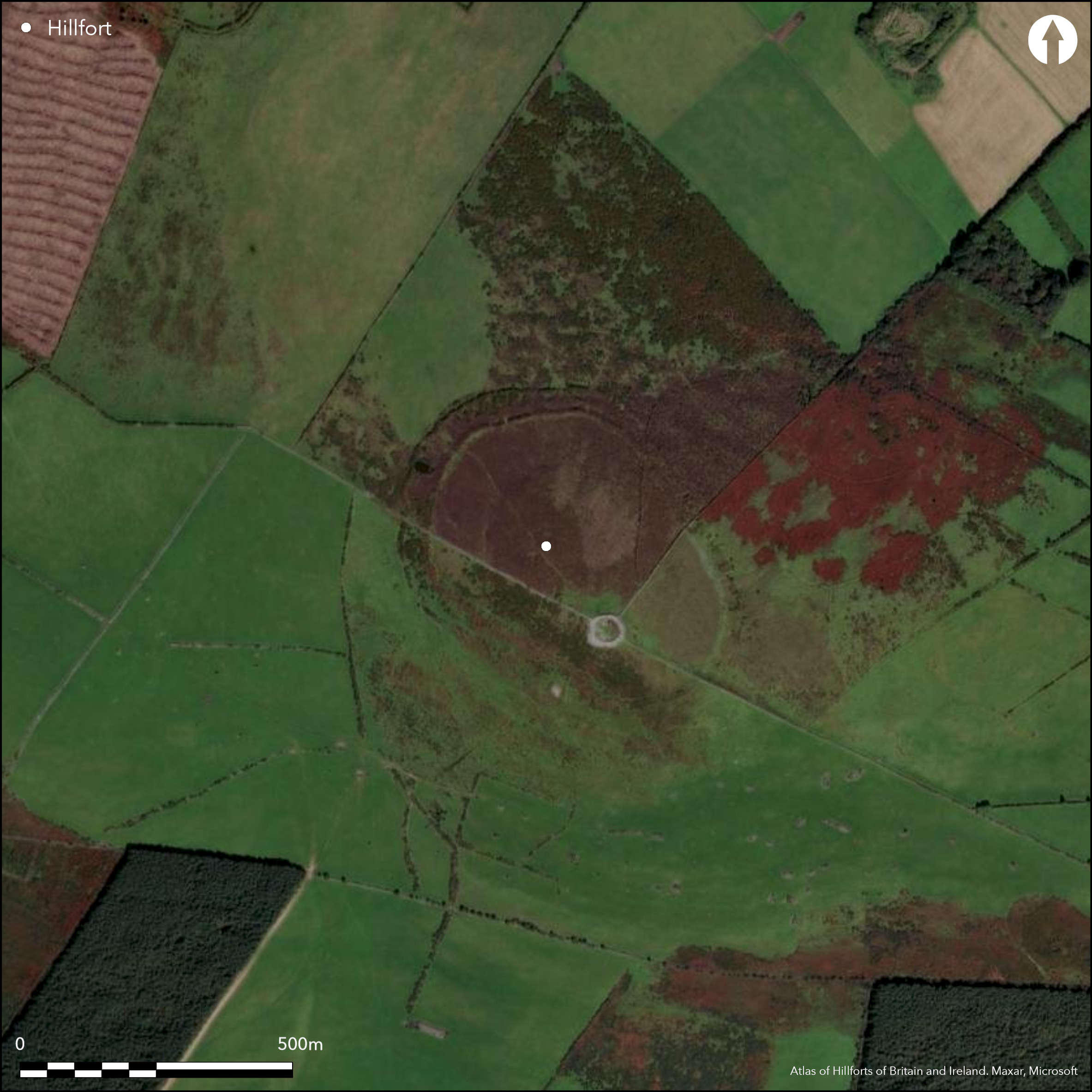
Around 1000 BC a later community built a bivallate – double-banked – hillfort around the old cairn, enclosing roughly 10 hectares (25 acres) and making this one of the largest hillforts in Wicklow. The Irish name reflects the overlap: Ráth Cuaráin (‘Cuarán’s ringfort’) or possibly Ráth Charnáin (‘ringfort of the cairn’). The ramparts follow the hill’s contour, up to about 16 m wide and nearly 3 m high on the northern and north-western flanks.
The fort was never finished. Quarry pits and banks that stop abruptly point to a sudden halt in the work, and a planned third rampart was left incomplete. LiDAR and geophysical surveys have since mapped up to fifty circular hut platforms inside the enclosure, so people clearly stayed on long after the ramparts were abandoned. In 2021 Wicklow County Council and the National Monuments Service funded further investigation through the Community Monuments Fund, presented by Dr Alan Hawkes.
What to see and do
- Find the chambers – The main north chamber and the secondary south tomb are the clearest features; look for the carved motifs on the south stones and the smooth basin in the central chamber. A smaller corbelled structure sits to the north-west, and a fifth chamber lies within the outer kerb to the east.
- Trace the ramparts – The inner and outer banks read best on the northern approach. Be warned that dense gorse and scrub cloak much of the interior, so the layout is easier to feel than to see – come in late winter or early spring, before the growth thickens, if you want to make sense of it.
- Take in the views – The summit gives unobstructed sightlines over the Slaney valley and the town of Baltinglass, with the Sugarloaf on the horizon on clear days.
Rathcoran is one of five hillforts around Baltinglass, together making up the wider Baltinglass hillfort complex – an unusual concentration for one small area.
Getting there and visitor info
- Access – A minor road climbs from Baltinglass, about 2 km east-north-east of the town centre. A small car park sits at the road’s end, with an unpaved trail to the summit. The climb is short but steep in places and best suited to reasonably fit walkers.
- Parking and facilities – Free parking at the trailhead. No toilets, shop or visitor centre on site, so bring water.
- Accessibility – Uneven ground, steep sections and low scrub; sturdy footwear needed, and not wheelchair-accessible.
- Dogs – Welcome but kept under close control, especially in spring and early summer when ground-nesting birds use the scrub.
- Safety – The summit is fully exposed; check the forecast, bring a windproof layer, and allow extra time if visibility drops.
For an overhead view of the enclosure, the Hillforts Atlas has detailed satellite mapping.
Nearby
- Baltinglass Abbey – A well-preserved 12th-century Cistercian abbey in Baltinglass itself, easily paired with the hill.
- Keadeen Mountain – More walking and elevated views over the same valley.
- Dwyer-McAllister Cottage – A restored thatched cottage nearby, showing traditional Wicklow building.