
Overview
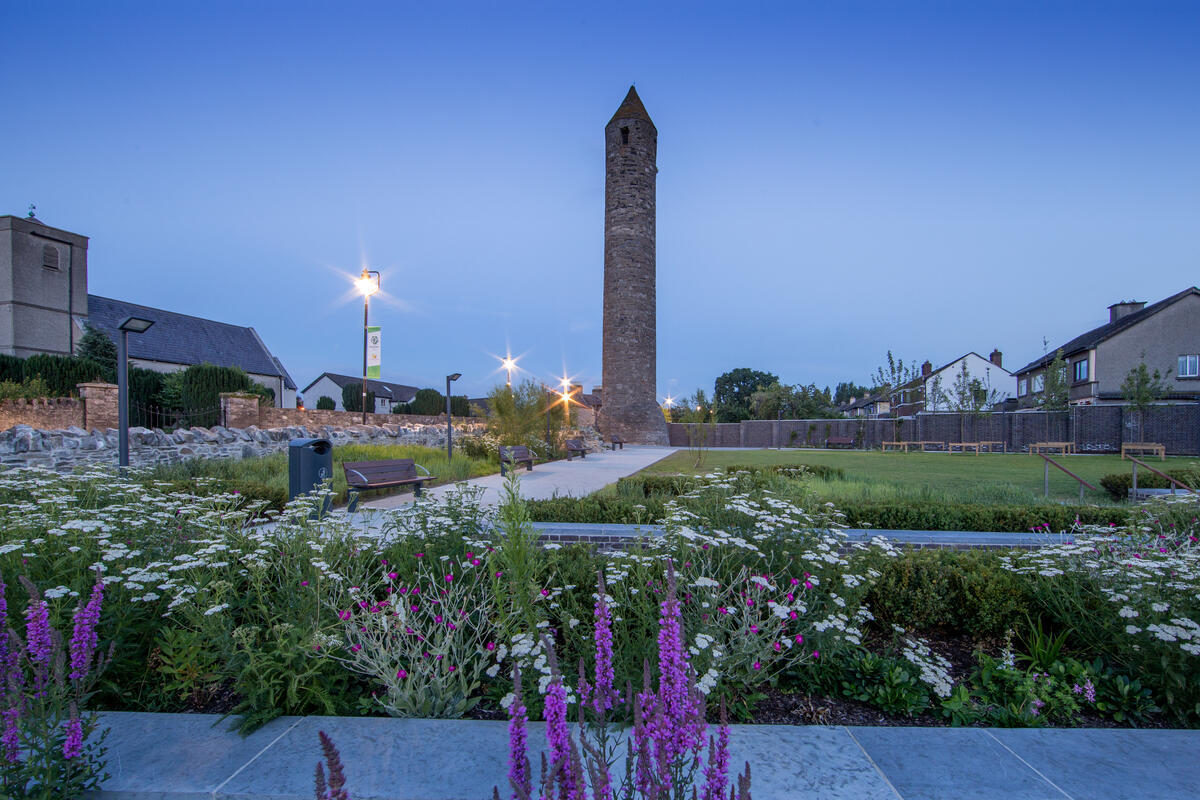
St Finian’s Esker, often called Esker Church, sits on a low ridge in the suburb of Esker, just outside the village of Lucan in County Dublin. The site commands views over the surrounding countryside and marks a point on the Esker Riada, the glacial ridge that became the medieval Slighe Mhór – one of Ireland’s five great ancient routes. Both the ruined church and its enclosed graveyard are protected structures owned by South Dublin County Council and are open to the public at any time.
History
The church’s origins reach back to the 11th century, making it one of the oldest ecclesiastical foundations in the Dublin hinterland. It served as the parish church for the medieval Royal Manor of Esker, one of the four royal manors that surrounded Dublin. Architectural evidence shows a nave‑and‑chancel layout that was re‑roofed in the 16th century, but the building fell into ruin by the early 17th century. The surviving west gable wall is buttressed and once supported a double bellcote; a distinctive double‑ogee arch window graces the south wall, while a short stretch of herringbone masonry in the north wall is a rare feature in Irish churches.
The graveyard began to be used in the early 19th century, and a transcription published in 1989 records roughly sixty memorials. Notable stones include the 1807 monument to Father James McCartan, murdered in nearby Lucan, and a striking skull‑and‑crossbones memento mori stone that reminds visitors of the site’s long‑standing role as a place of remembrance.
The ruin sits close to the historic King John’s Bridge, a 13th‑century stone bridge that once carried the Slighe Mhór across the River Liffey. The bridge is still visible from the hilltop and adds another layer of medieval landscape to the visit.
In 2019 the monument was selected for the Heritage Council’s Adopt a Monument scheme – the first Dublin site to join the programme. Conservation work started in October 2020, funded by the National Monuments Service Community Monuments Fund and South Dublin County Council. A further Heritage Council grant in 2022 supported additional stabilisation work. The Society for Old Lucan, a local heritage group, adopted the site in 2017 and continues to promote research, conservation and public awareness. The graveyard was surveyed again in 2021, updating the record of the 68 memorials recorded by Historic Graves.
Heritage and Conservation
St Finian’s Esker benefits from a series of recent heritage initiatives. The Heritage Council’s Adopt‑a‑Monument programme provided the initial funding for a detailed architectural assessment and a geophysical survey in 2019, which identified possible earlier church foundations beneath the current ruins. Subsequent grants in 2020 and 2022 enabled structural stabilisation of the west gable and conservation of the surrounding wall.
The Society for Old Lucan, established in 2017, manages the day‑to‑day stewardship of the site. Their activities include regular clean‑up days, heritage talks, and the promotion of the monument on social media. The group also collaborates with South Dublin County Council and the National Monuments Service to ensure the site remains protected and accessible.
Research and Records
The graveyard is listed on the Historic Graves database (site code DU017‑022002) as a rectangular burial ground containing 68 recorded memorials. The database provides a searchable catalogue of individual stones, many of which date from the 18th and 19th centuries. Earlier documentation by Dr M.J. Egan in 1989 recorded about sixty stones; the 2021 survey added further entries and updated condition reports.
These records are valuable for genealogists and local historians, offering insight into family names, occupational titles and mortality patterns in the Lucan area over two centuries.
What to See & Do
Visitors can wander among the stone‑lined ruins, tracing the outline of the original nave and imagining the medieval congregation that once gathered here. The west gable wall with its buttresses offers a dramatic backdrop for photographs, while the double‑ogee window provides a glimpse of the craftsmanship that survived centuries of weathering.
The graveyard invites quiet contemplation. Walk the narrow paths to view the early‑19th‑century headstones, the Father McCartan memorial, and the memento mori stone with its carved skull. The layout of the burial ground reflects changing funerary fashions over two centuries, making it a valuable resource for anyone interested in Irish social history.
Because the site sits on the historic Slighe Mhór, it is also a waypoint for walkers exploring the Esker Riada trail. The gentle rise of the hill offers panoramic views of the surrounding fields and the modern housing that now surrounds the monument, creating a striking contrast between past and present.
Walking the Esker Riada Trail
The Esker Riada is a long‑distance walking route that follows the ancient glacial ridge from Dublin to the north‑west. St Finian’s Esker forms a convenient rest point on the southern section of the trail, with marked way‑markers nearby. The walk is suitable for all abilities and provides opportunities to spot local wildlife, especially in spring when the surrounding fields burst into colour.
Events & Community Activities
The Society for Old Lucan keeps the site active through occasional clean‑up days, heritage talks and the promotion of the Adopt a Monument project. Updates and event notices are posted on their Facebook pages (Old Lucan and St Finian’s Esker). Visitors are welcome to join these activities and help preserve the monument.
Practical Information
St Finian’s Esker is free to visit and has no formal opening hours; the site is accessible at any time, day or night, though daylight is recommended for safety and optimal viewing. The church and graveyard are owned and maintained by South Dublin County Council.
Location & Access – The ruin lies on Kerkstraat in the Esker area of Lucan. It is reachable by car via the N4 and local roads; limited on‑site parking is available on the adjacent residential streets (please respect local residents). Public transport options include the Lucan DART station (approximately 2 km away) and several Dublin Bus routes that stop in Lucan village. From the bus or train stop, a short walk north along the main road leads to the hilltop site.
Family‑friendly – The site is level and safe for children, with open grass and clear paths. Strollers can be used on the main walkways.
Visiting Tips –
- Parking: There is no dedicated car park; visitors typically use street parking on nearby residential lanes. Check for any local restrictions before leaving your vehicle.
- Pets: Dogs are welcome on a leash, but be mindful of the graveyard and other visitors.
- Safety: The ground is uneven in places; sturdy footwear is advisable.
Conservation & Community – The Society for Old Lucan monitors the monument and posts updates on its Facebook pages. Visitors interested in supporting the ongoing preservation can contact the society through these pages.
Coordinates – 53.3498953 N, ‑6.4378233 W.
| Item | Details |
|---|---|
| Latitude | 53.3498953 |
| Longitude | -6.4378233 |
| Access | Free, open access (no formal hours) |
| Nearest public transport | Lucan DART station, Dublin Bus routes to Lucan village |
| Managing authority | South Dublin County Council |
Nearby Attractions
While in the area, consider a short drive to other points of interest in north‑west Dublin:
- Ardgillan Castle – a 17th‑century mansion with formal gardens and a coastal promenade, about 15 km north‑east.
- Lucan Village – historic streets, the 12th‑century Lucan Castle ruins and a range of cafés.
- King John’s Bridge – the medieval stone bridge mentioned above, a pleasant spot for a photo.
The site’s quiet, contemplative atmosphere makes it an ideal stop for history enthusiasts, genealogy researchers, families and anyone seeking a peaceful spot to reflect on Ireland’s layered past.
For the latest news on conservation work or community events, follow the Society for Old Lucan on Facebook.