
Overview
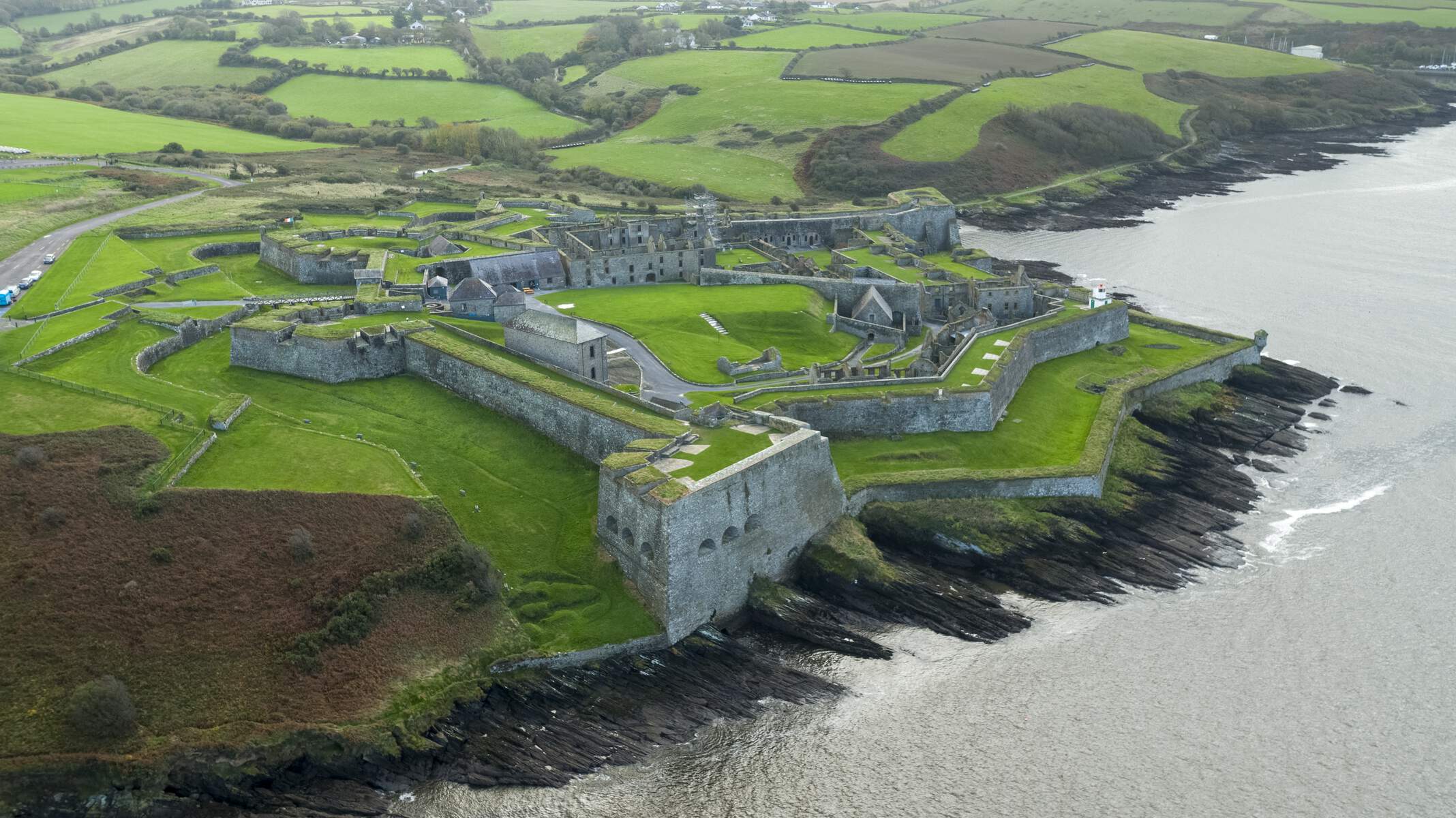
Charles Fort, often referred to as the “Star Fort” of Kinsale, dominates the entrance to Kinsale Harbour on the south‑west coast of County Cork. Designed by the eminent Surveyor‑General Sir William Robinson, the fort was constructed from 1677 to 1682 under King Charles II. Its pentagonal layout, with five projecting bastions, follows the classic trace‑italienne principle that allowed defenders to fire along every wall face while presenting a low, thick profile resistant to cannon fire. Today the site is managed by the Office of Public Works (OPW) and is a National Monument attracting close to 100 000 visitors a year.
History
The fort sits on the ruins of the medieval Barry Óg Castle, a strategic stronghold during the 1601 Siege of Kinsale. Robinson’s design incorporated two massive seaward bastions – the “Devil’s” and the “Charles” – to guard against naval attack, while three landward bastions (North, Flagstaff and Cockpit) protected the rear. In October 1690, during the Williamite War, the fort endured a 13‑day siege. Jacobite defenders, outnumbered and vulnerable on the land side, eventually surrendered after the Cockpit Bastion was breached by heavy artillery.
After the siege the British Army used the fort as a barracks. It was garrisoned by the Essex Regiment during the Irish War of Independence (1919‑1921). In February 1922 anti‑Treaty forces set fire to the interior, leaving much of the interior roofless and in ruins – a scar that is still visible today. The fort was declared a National Monument in 1973 and extensive restoration by the OPW has returned the ramparts, bastions and command quarters to a visitor‑friendly condition. The centenary of the hand‑over in 2022 was marked by speeches and historical re‑enactments organised by local heritage groups, underscoring the site’s continued relevance.
Design and Architecture
Charles Fort is a textbook example of a 17th‑century star fort. Its five bastions – Devil’s, Charles, North, Flagstaff and Cockpit – project outward, creating a “star” shape that eliminates blind spots. The seaward bastions retain original gun‑ports, while the landward bastions feature brick sentry boxes, surviving casemates and a flagstaff bastion that once housed a small lighthouse for coastal navigation. A series of ravelins and a dry ditch augment the defence, and the low, thick walls were specifically designed to absorb cannon fire.
The complex also includes former coast‑guard cottages and the remains of a small lighthouse that once guided ships into Kinsale Harbour. These ancillary buildings give a glimpse of the everyday life of the garrison and the maritime support network that surrounded the fort.
Lighthouse and Coast‑guard Cottages
The Flagstaff Bastion originally supported a modest lighthouse, operational from the late 17th century until the late 20th century, when it was replaced by the modern automated light on the Old Head of Kinsale. The adjacent coast‑guard cottages, still standing, illustrate the dual military‑civil role of the site and are featured in several Heritage Ireland photographs.
What to See & Do
- Ramparts and Bastions – Walk the 12‑acre perimeter walls, up to 16 m high, and explore the five bastions. The seaward bastions still contain original gun‑ports, while the landward bastions showcase brick sentry boxes and surviving casemates.
- Panoramic Views – From the ramparts you can see the colourful town of Kinsale, James Fort opposite the harbour, the Old Head of Kinsale and, on clear days, the Atlantic horizon.
- Charles Fort Walk – An 8‑acre coastal path leads eastward to Preghane Point, extending the visit with cliff‑side scenery and sea‑bird spotting.
- Exhibits & Panels – Inside the former barracks are displays on the fort’s engineering, the 1690 siege and the 1922 fire, presented in eight languages.
- Guided Tours – OPW guides provide a narrative of the fort’s military engineering and dramatic episodes; tours are included in the ticket price and depart from the reception desk.
- Self‑Guided Exploration – Free leaflets are available at the entrance for those who prefer to wander at their own pace.
- Family Treasure Hunt – A printable activity sheet for children (available at the visitor centre) turns the walk into a scavenger‑hunt, highlighting historic features.
Visitor Centre & Learning Resources
The on‑site visitor centre houses a detailed scale model of the fort and a series of interactive panels. For school groups, Heritage Ireland provides a Social‑Story learning pack that includes a colour‑coded mosaic ground‑plan and teacher notes linking the fort’s architecture to broader themes of 17th‑century military engineering. The pack can be downloaded from the Heritage Ireland site here.
Events and Activities
- OPW Guided Tours – Available in English, Irish, French, German, Spanish, Italian, Dutch and Polish.
- Historical Re‑enactments – During the summer months, local heritage groups stage short re‑enactments of the 1690 siege. In 2022 a centenary commemoration featured speeches, period dress and cannon fire demonstrations.
- First Wednesday Free Entry – All visitors can enter free of charge on the first Wednesday of each month.
- Special Exhibitions – Periodic temporary displays explore topics such as coastal defence, the 1922 fire and the role of the fort in the wider network of Cork Harbour fortifications.
Practical Information
Opening hours
| Season | Opening time | Last admission |
|---|---|---|
| 1 January – 15 March | 10:00 am | 4:00 pm |
| 16 March – 31 October | 10:00 am | 5:00 pm |
| 1 November – mid March | 10:00 am | 4:00 pm |
Admission fees
| Category | Price |
|---|---|
| Adult | €5.00 |
| Senior / Group | €4.00 |
| Child (12‑17) / Student | €3.00 |
| Family (2 adults + 2 children) | €13.00 |
| Children under 12 | Free |
| First Wednesday of each month | Free for all visitors |
Tickets can be bought on‑site or booked up to 60 days in advance via the OPW portal here. Larger groups should email the booking office at charlesfort@opw.ie.
Accessibility – The site features uneven, sloped and occasionally slippery surfaces; limited edge protection is provided. It is not fully wheelchair‑accessible. Visitors with limited mobility are advised to contact the office beforehand (+353 21 477 2263) for assistance.
Facilities – Handrails are installed at key points; drones are prohibited; children must be accompanied by an adult. Restrooms are located near the entrance.
Getting there – The fort is a 5‑minute drive from Kinsale town centre, with free roadside parking and a small on‑site car‑park that fills quickly in summer. It is also reachable on foot via the 30‑minute Scilly Walk or by the 4 km coastal cycle route described on ActiveME. Public‑transport options (bus routes, nearest train station) should be confirmed before travel.
Contact
- Phone: +353 21 477 2263
- Email: charlesfort@opw.ie
- Website: https://heritageireland.ie/places-to-visit/charles-fort-military-fortress/
Nearby attractions
After exploring the fort, consider a stroll to Preghane Point, a visit to James Fort across the harbour, or a walk along the coastal path to the Old Head of Kinsale. Kinsale itself offers a range of seafood restaurants, boutique shops and the historic Desmond Castle (open seasonally). For a deeper dive into Cork’s military heritage, the network of forts around the harbour – including the nearby James Fort – can be visited on the same day.
Charles Fort offers a rare blend of military engineering, dramatic history and unrivalled coastal scenery – a compelling destination for history enthusiasts, families and anyone seeking an engaging Irish outdoor experience.