
Overview
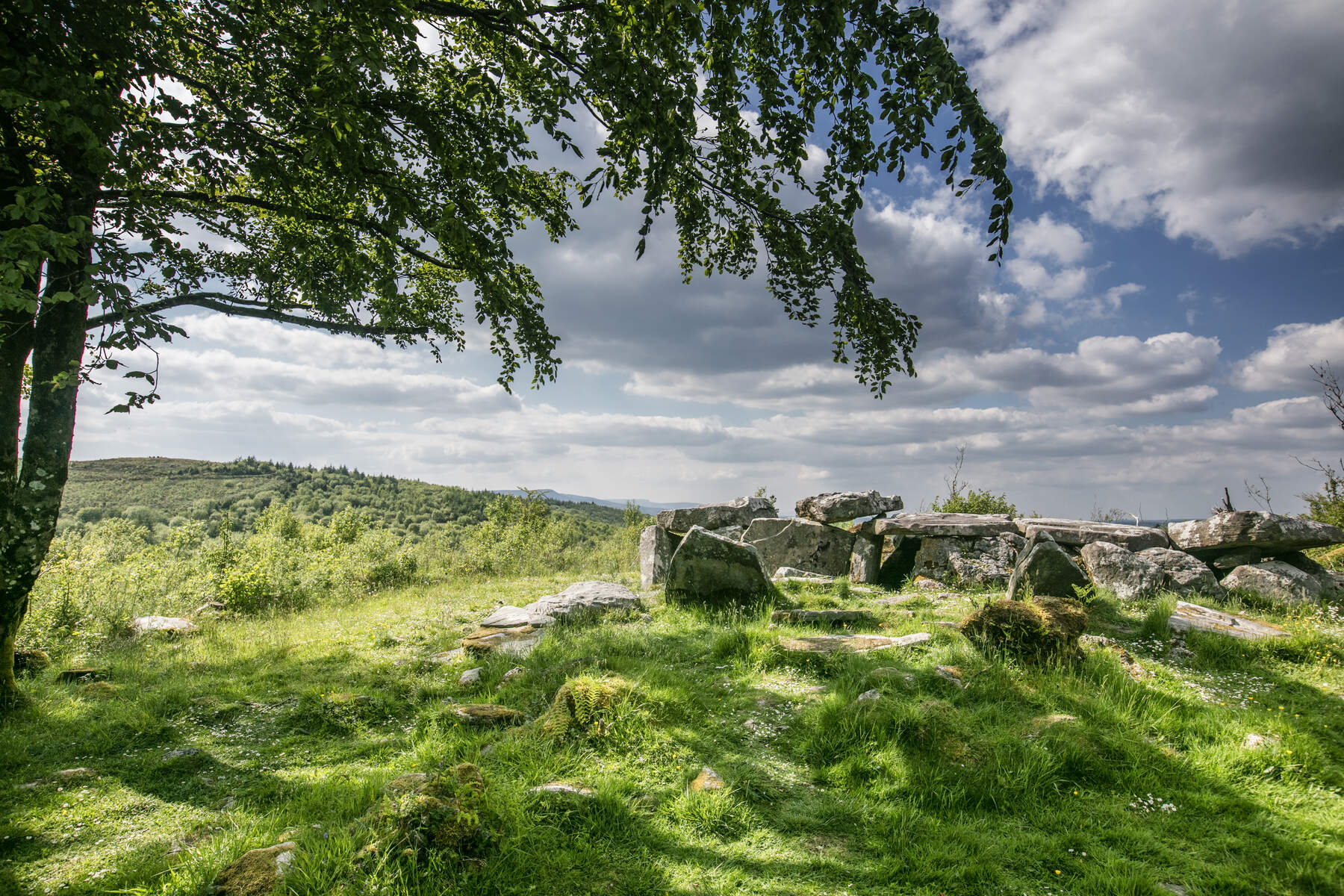
Tullygobbin Wedge Tomb sits on the rolling limestone plateau of the Cavan Burren, a geopark celebrated for its rich tapestry of prehistoric monuments, glacial erratics and striking karst landforms. The tomb forms part of the Green Trail, a well‑marked route that weaves through the park’s most iconic archaeological sites. Its simple, tapering silhouette – wider and taller at the entrance and narrowing toward the rear – is characteristic of Ireland’s wedge‑type tombs, the most numerous class of megalithic burial structures in the country.
Geology & Landscape
The Cavan Burren sits on a Carboniferous limestone plateau that dates back roughly 340 million years, when tropical seas covered the area. Over successive ice ages, glaciers sculpted the karst landscape, leaving sinkholes, dolines and massive glacial erratics. The site is part of the Cuilcagh Lakelands Geopark, recognised by UNESCO for its geological heritage. Visitors can see the interplay of ancient stone monuments with living geological processes – for example, the “Lost Valley” where a pre‑glacial river once disappeared underground.
History
Wedge tombs belong to the Chalcolithic period, a transitional era between the Neolithic and Early Bronze Age (c. 2500–2000 BC) when copper tools first appeared on Irish soil. Tullygobbin is thought to be named after Gobán Saor, a legendary master craftsman from Irish folklore, hinting at the cultural resonance the site has held for centuries.
The monument originally comprised a stone chamber capped by two large slabs; today only the southeast side remains relatively intact, with two broken capstones still sheltering the burial chamber on the northeast side. Its dimensions – roughly 8.9 m long and 2.05 m wide at the entrance – make it a substantial example of the type, even though weathering has taken its toll.
Cavan Burren Park opened to the public in May 2014 and quickly became a flagship site within the geopark network. The park’s interpretative centre, wheelchair‑friendly Trail 1 and free admission have helped it become a popular family destination.
Folklore & Legends
Local tradition links the tomb to a tale of two young giants, Lugh and Lag, who competed for the affection of a female giant. To prove their worth they attempted to leap a deep gorge – now known as the Giant’s Leap. Lag fell to his death and, according to legend, was buried at the site that later became known as the “Giant’s Grave”, another name for Tullygobbin Wedge Tomb. The story is recounted on signage throughout the park and adds a vivid layer of myth to the stone setting.
What to See & Do
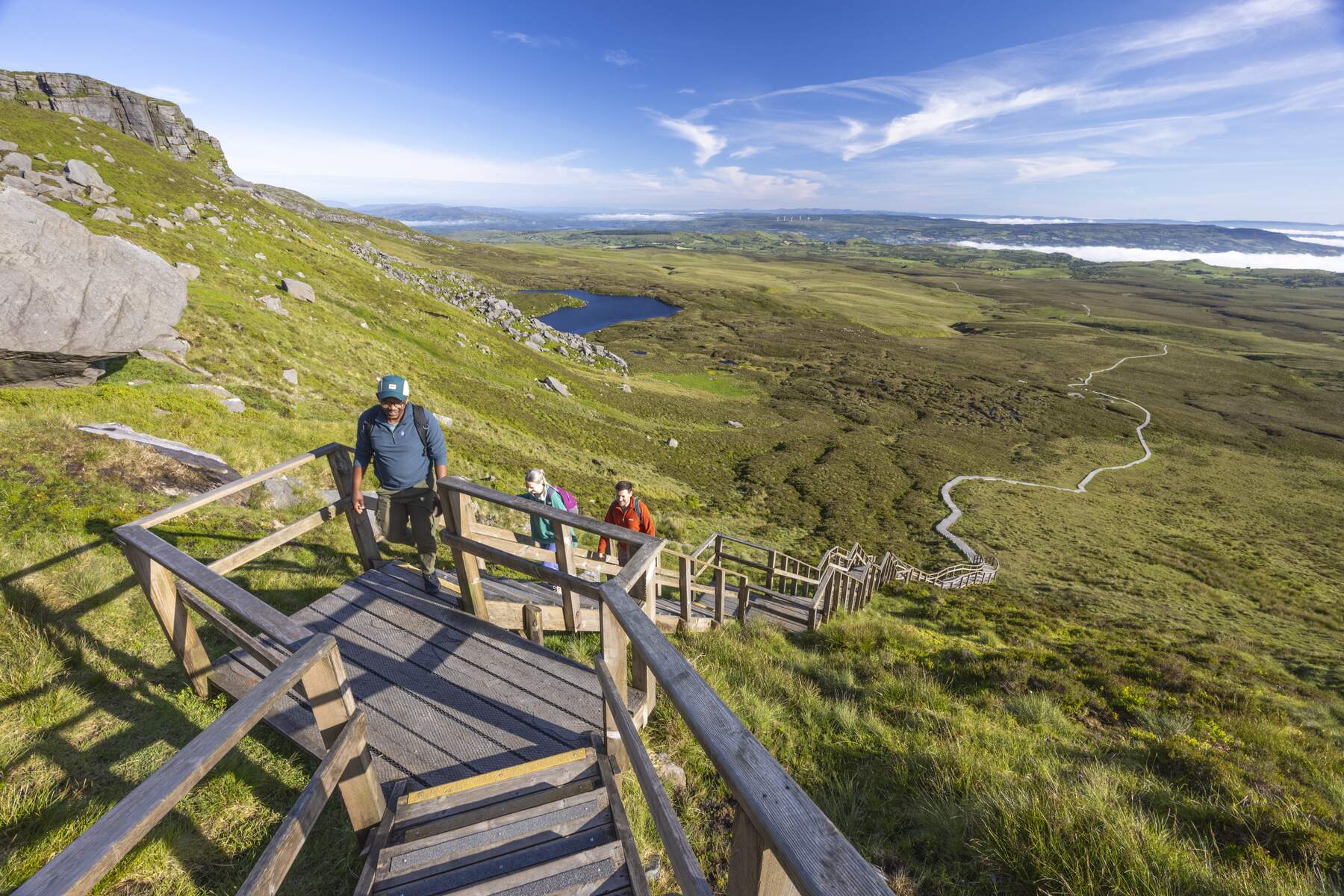
Walking the Green Trail, visitors encounter Tullygobbin alongside several other highlights:
- Tullygobbin Wedge Tomb – Observe the remaining orthostats and capstones, and imagine the original mound that once covered the chamber.
- Tullygobbin Viewpoint – A short detour offers a 360° panorama of the surrounding limestone plateau, Cuilcagh Mountain and the patchwork of fields beyond.
- Calf House Dolmen – A nearby portal tomb dating to the earlier Neolithic, providing a contrast in architectural style.
- Glacial Erratics and Sinkholes – Massive boulders deposited by Ice Age glaciers and dramatic dolines punctuate the landscape, underscoring the geological depth of the area.
- Interpretative Centre – Located at the main car park, the centre houses displays that explain the archaeology, geology and folklore of the Burren.
The trail is well‑signposted and includes a wooden boardwalk that protects delicate vegetation while offering clear sightlines to the tomb. For those interested in audio‑learning, the Amplify Archaeology Podcast (episode 6) features Dr Neil Carlin discussing wedge tombs and can be streamed via the park’s website.
Trails Overview
Cavan Burren Park offers five marked routes. The most accessible is Trail 1 – Calf House Dolmen Trail (1 km, ~35 min, wheelchair‑friendly). Other routes include:
- Trail 2 – Giant’s Leap Trail (3 km, ~50 min). This path leads to the larger Giant’s Leap wedge tomb, the historic limekiln and the dramatic “Giant’s Leap” dry valley. It is not wheelchair‑accessible and includes some bog‑bridge steps.
- Trail 3 – Promontory Fort Trail (3 km, ~1 hour). Walk past a well‑preserved Iron Age promontory fort, additional sinkholes and relict farm walls.
- Trail 4 – Tullygobbin Lough Trail (1.5 km, ~45 min). Highlights the biodiverse Tullygobbin Lough, desiccated sandstone outcrops and further glacial erratics.
- Trail 5 – The Cavan Way (long‑distance, 26 km). A section of this national way passes through Trail 2, linking Blacklion with neighbouring villages. See the dedicated page for the Cavan Way.
All trails are marked on the park map (available at the interpretative centre) and vary in difficulty, allowing families, casual walkers and more experienced hikers to choose a route that suits them.
Visitor Facilities & Learning
- Interpretative Centre – Free entry, with interactive displays, teacher‑focused worksheets and downloadable PDFs (student, teacher and information sheets) for school groups.
- Public amenities – Toilets, a picnic area and a small café in Blacklion village. Parking is free and spacious for cars and coaches.
- Accessibility – Trail 1 is fully wheelchair‑friendly; the boardwalk provides a smooth surface throughout the key points.
- Dog policy – Dogs are welcome on leashes on all trails; owners must carry out waste as there are no litter bins on the paths.
- Audio guide – The Amplify Archaeology Podcast (episode 6) offers a 10‑minute audio tour that can be streamed from the park’s website.
Practical Information
Getting there – From Blacklion, take the N16 south and turn left onto the sign‑posted road to Cavan Burren Park. Follow the signs for about 4 km; the main car park sits on Cornagee Road. Parking is free and ample for both cars and coaches.
Trail access – The tomb is reached via Trail 1 (the Calf House Dolmen Trail). This 1.2 km circular walk starts at the interpretative centre car park, takes around 35 minutes, and is wheelchair‑accessible. The route passes the tomb, the Tullygobbin Viewpoint, the Lost Valley viewpoint and several glacial erratics.
Opening times & fees – The park is open year‑round; opening hours vary with the season (see the park’s website for the latest times). Admission is free for all visitors.
Facilities – Public toilets, a picnic area and a small café in the nearby village of Blacklion are available. Dogs are welcome on leashes; there are no litter bins on the trails, so visitors should carry out any waste.
Safety notes – The tomb’s stonework is fragile; stay on the designated path and avoid climbing on the orthostats. The terrain can be uneven, especially after rain, so wear sturdy, waterproof footwear.
Visiting Tips
- Clothing – The Burren is exposed to wind and rain; bring warm, waterproof layers and sturdy walking shoes.
- Food & Drink – No refreshments are sold on site. Pack a lunch and water, and use the picnic area near the car park.
- Accessibility – Trail 1 is fully wheelchair‑friendly; the boardwalk protects the surrounding vegetation and provides a smooth surface.
- Dog policy – Dogs are allowed on leashes; remember to remove waste as there are no bins on the trail.
- Photography – The viewpoint offers excellent sunrise and sunset light; a wide‑angle lens works well for capturing the expansive plateau.
- Seasonal note – The park is generally open during daylight hours; winter days are shorter, so plan to start early.
Nearby Attractions & Walks
- Cuilcagh Mountain – Visible from the viewpoint, the mountain can be tackled via the Cuilcagh Boardwalk Trail (see the Cuilcagh Lakelands Geopark site for details).
- The Cavan Way – A 26 km long‑distance trail that traverses the Burren and links Blacklion with neighbouring villages; sections of it intersect Trail 1.
- Giant’s Leap Wedge Tomb – Located on the Orange Trail, this larger wedge tomb features cup‑and‑ring rock art and is another highlight for archaeology enthusiasts.
- Calf House Dolmen – The portal tomb mentioned above is a short walk from Tullygobbin and provides a contrasting Neolithic experience.
- Glencar Waterfall & Shannon Blueway – Both are listed in Discover Ireland’s “Top free things to do” for the wider Hidden Heartlands region and make excellent day‑trip extensions.
Whether you are an archaeology enthusiast, a casual walker, or a family looking for a free outdoor adventure, Tullygobbin Wedge Tomb offers a tangible connection to Ireland’s deep past set against a landscape of striking natural beauty.