
Overview
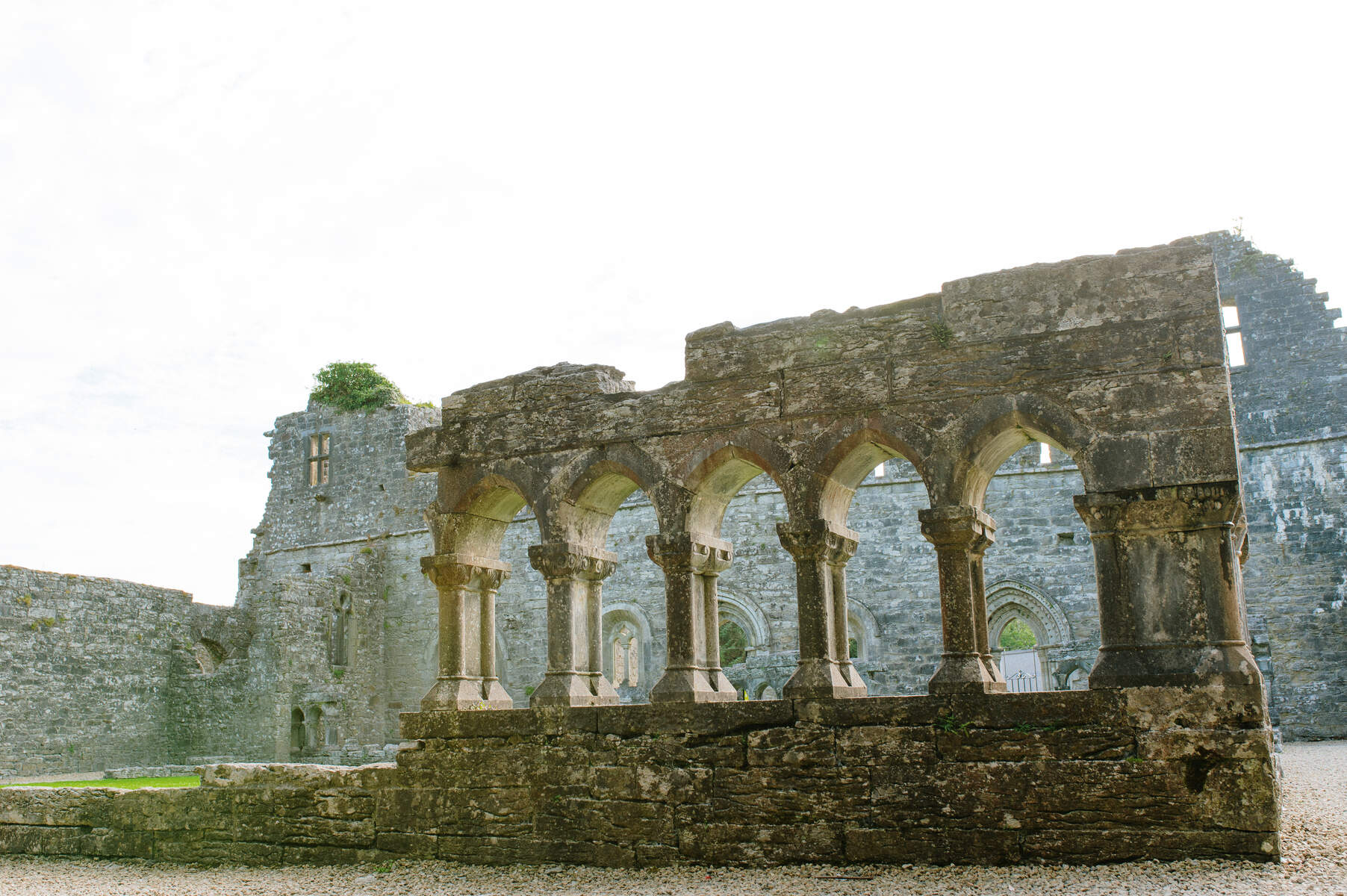
Rathfran Abbey, also known as the Priory of the Holy Cross, crowns the left bank of the Avonmore (Cloonaghmore) River a few kilometres north of Killala, County Mayo. The ruin commands a picturesque position above a tidal creek, sheltered to the north and west by low grassy hills. It is a recognised stop on the Wild Atlantic Way and sits amid a landscape dotted with ancient earthen forts, stone “giant graves” and the nearby Rathfranpark wedge tomb.
History
The abbey was founded in 1274 by the Norman couple William de Burgh (the “Grey”) and his wife Finola d’Exeter – some later sources also credit the Exeter or Dexter families. Dedicated to the Holy Cross, it quickly became a focal point for the Dominican Order in Connacht. The original complex comprised a long rectangular church, a lateral south chapel, two cloisters to the north and a range of domestic buildings, including a vaulted room attached to the church.
Architecturally the church displayed classic Early English Gothic features: a fine triple‑lancet east window (now reduced to its side piers), a small crucifixion panel set above the west doorway, and a series of lancet windows along the south wall, some later blocked and rebuilt. The south wall also held a trefoil‑headed piscina with two basins and a semi‑circular sedile. Inside the chancel, two richly carved grave‑slabs now stand on either side of the high altar – one bearing a Latin inscription thought to read “Joannes O’Munilay me fiery fecit 1018” and the other an elaborate interlaced Celtic design.
The friary suffered repeatedly. By 1451 it was recorded without a refectory, bell‑tower or bell; in 1513 Edmond de Burgo was slain within its walls; and in 1590 Sir Richard Bingham’s army burned the complex during the Tudor suppression of the monasteries. Despite the devastation, a small Dominican community lingered into the eighteenth century, with the last recorded prior, Father Denis Meagher, dying between 1785 and 1789.
Conservation work by the Office of Public Works in the 1970s repositioned the two altar‑side grave‑slabs to protect their intricate carvings. Local folklore adds colour: a tale tells of Colonel Knox’s gold from a wrecked British cruiser being buried near the abbey after a storm‑ridden night in the early nineteenth century – a hoard that has never been recovered.
What to See & Do
- Church ruins – Walk the flag‑stone floor of the roofless nave and admire the surviving south and west lancet windows, the crucifixion panel, and the fine buttresses that frame the west gable.
- Triple‑lancet east window – Although the ornate frame was shattered in the 1839 “Night of the Big Wind”, the side piers and moulded angle shafts remain, hinting at its former splendour.
- Cloister foundations – The faint outlines of the two northern cloisters are still visible, offering a tangible sense of the monastic courtyard.
- Grave‑slabs – The high‑relief slabs flanking the altar showcase intricate Celtic motifs and rare medieval inscriptions.
- Landscape views – From the abbey you can gaze across the tidal Avonmore River into Killala Bay, with the Ox Mountains of Sligo forming a dramatic backdrop. The surrounding low hills provide ideal spots for quiet contemplation or photography.
Getting there
Rathfran Abbey is accessed via the R310 road from Killala (approximately 4 km north of the town). A short, sign‑posted turn‑off leads to a small lay‑by where visitors can park. The site is reachable by car, and local bus services run between Ballina, Castlebar and Killala; the nearest scheduled stop is in Killala, from where the abbey is a brief walk north along the riverbank. Check the latest bus timetables before travelling, as services are limited on weekends.
Nearby attractions & walking routes
- Rathfranpark wedge tomb – A short walk east of the abbey, this prehistoric burial monument adds a deeper sense of antiquity to the area.
- Killala Bay – The tidal bay below the abbey is perfect for a coastal stroll; the Killala Heritage Trail links the abbey with the historic town centre and the 17th‑century Killala Cathedral.
- Ballycroy (Wild Nephin) National Park – About 30 km west, this expansive park offers rugged mountain walks, wildlife spotting and the famous Nephin Mountain trail.
- Ox Mountains – Visible from the abbey, the range can be explored via several marked routes originating from nearby villages such as Ballina.
Practical Information
- Opening hours – Open year‑round, 24 hours (no staff, free entry).
- Parking – A small lay‑by provides limited spaces; early arrival in peak summer months is advisable.
- Facilities – There are no toilets, café or visitor centre on site. Bring water and a packed snack if you plan to stay for a while.
- Accessibility – The site is uneven and includes loose stone slabs; it is best suited to visitors with reasonable mobility and sturdy footwear.
- Weather – The Atlantic coast can be windy and rainy; a waterproof jacket and sturdy shoes are recommended. Tidal levels affect the creek view, so check tide tables if you wish to walk along the water’s edge.
Seasonal tips
- Spring & early summer bring a burst of wildflowers on the surrounding hills, making the walk to the wedge tomb especially scenic.
- Autumn offers dramatic light on the ruins and quieter visitor numbers.
- Winter can be windy and the tide higher; ensure you have warm clothing and watch for slippery stones.
Enjoy the quiet atmosphere, the sweeping Atlantic vistas and the palpable sense of history that makes Rathfran Abbey a rewarding stop on any Mayo itinerary.