
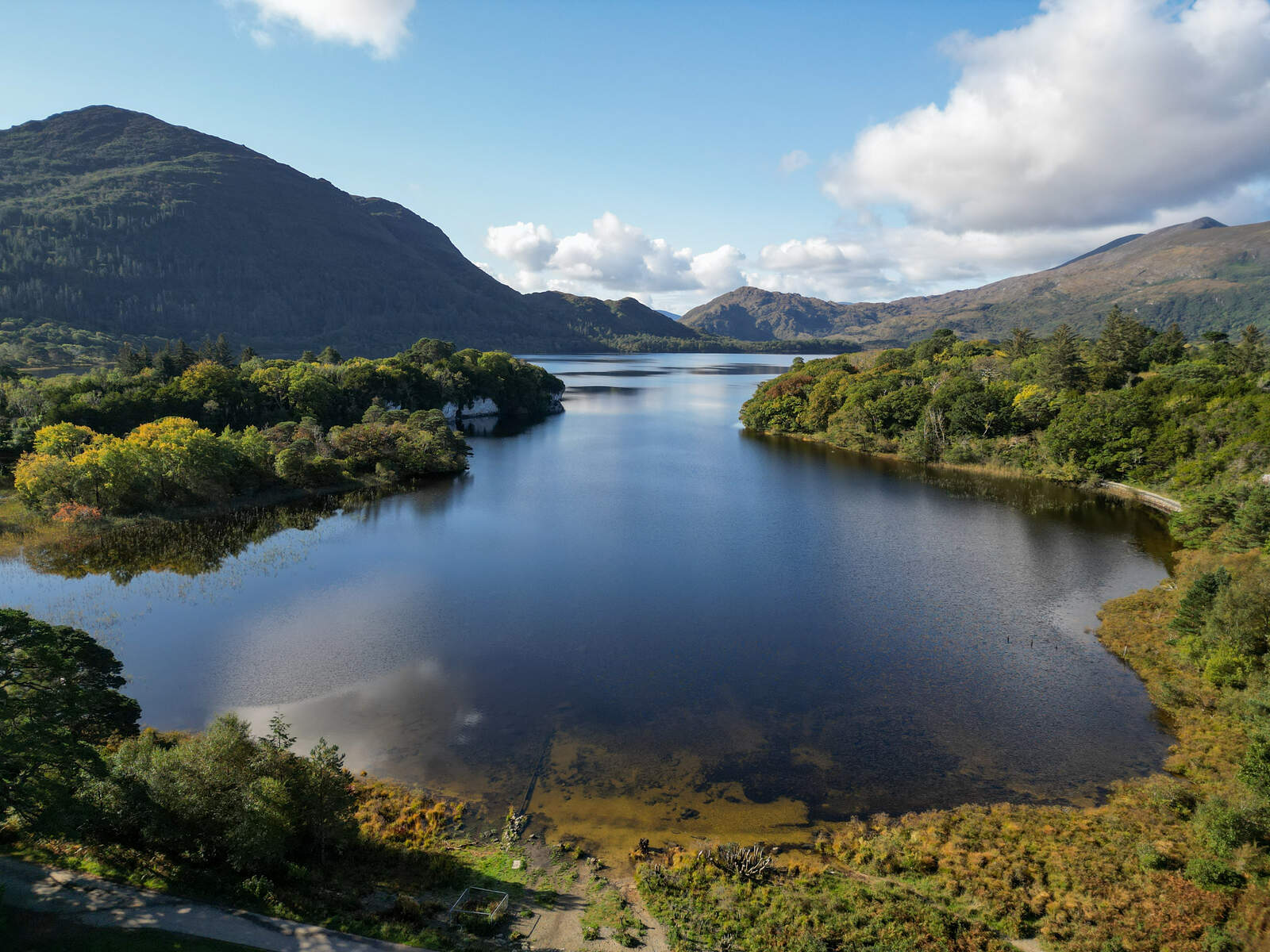
Overview
Dunkerron Castle rises dramatically from a limestone outcrop just 2 miles west of the charming town of Kenmare, on the Sneem Road (R569). The four‑storey tower house, built in the 13th century as a Norman stronghold, commands sweeping views across Kenmare Bay toward the Beara Peninsula. While the south, east and west walls have partially collapsed, the north wall still reaches its full 18.3 metre height, giving a clear impression of the castle’s original defensive strength.
The ruin sits within a privately‑owned estate that now hosts the Dunkerron Holiday Homes, a collection of three‑ and four‑bedroom wooden houses set amid parkland, gardens and new plantations. The estate forms part of the Ring of Kerry, making it an ideal launch‑pad for coastal drives, historic towns and the rugged Dunkerron Mountains.
History
The stone tower began life in the 1200s as a Norman (Carew) fortification. In the late 16th century the O’Sullivan Mór family, led by Owen O’Sullivan, transformed the site into their principal residence. An inscribed plaque dated 1596 records the joint patronage of the O’Sullivan Mór and MacCarthy Reagh dynasties. The castle’s architecture blends the original Norman core with a later enclosed court added in the 1590s, illustrating the evolution of Irish tower houses.
During the mid‑17th century Cromwellian conquest, the O’Sullivans defended the stronghold, but the 1652 Act for the Settlement of Ireland confiscated the property, granting it to William Petty, a Cromwellian supporter. The family’s attempts to reclaim the lands were unsuccessful. By the 19th century the castle and its court were recorded as ruins, and a Victorian manor, Dunkerron House, was erected on the estate.
Today the ruin is a tangible reminder of Kerry’s turbulent past, the rise and fall of Gaelic lordship, and the layered architectural history of Irish tower houses.
What to See & Do
Exploring the Ruins
Visitors can wander among the remaining walls, noting the thick (≈2.6 m) limestone masonry, the vaulted lobby on the ground floor, and the remnants of mural stairs that once linked the four storeys. The north wall still displays original embrasures and window loops, while a small turret on the south side hints at a possible oubliette dungeon. The site also features the concrete base of a former crazy‑golf course, adding a quirky modern contrast to the medieval stone.
Scenic Views
From the castle’s elevated position, the panorama stretches across Kenmare Bay to the Beara Peninsula, with the Iveragh Peninsula’s mountains forming a dramatic backdrop. Photographers will appreciate the interplay of light on the limestone and the ever‑changing sea‑sky horizon.
Luxury Holiday Homes
The Dunkerron Holiday Homes provide a comfortable, upscale base for exploring the area. Each house includes:
| Home Type | Bedrooms | Sleeps | Key Amenities |
|---|---|---|---|
| Three‑bedroom | 3 | 6 | Fully fitted kitchen, washer/dryer, gas‑effect fire, bed linen included |
| Four‑bedroom | 4 | 8 | Same amenities as three‑bedroom, plus larger living space |
All homes are set within wooded parkland, offering mountain views and easy access to the castle grounds. Bed linen is provided; towels can be hired.
Walking the Dunkerron Mountains
For active visitors, the Dunkerron Mountains present a rugged playground of glaciated peaks, coom lakes and cascading waterfalls. Guided walking holidays run from Álaind Walking, offering strenuous 8‑12 km routes that climb peaks such as Mullaghanattin (773 m) and Beann (775 m). A typical three‑day itinerary includes:
- Day 1 – Warm‑up ridge walk on the Kerry Way, spotting holy wells and coastal vistas.
- Day 2 – Summit‑focused trek to Mullaghanattin, with panoramic views of Kenmare Bay and the Iveragh Peninsula.
- Day 3 – A hidden‑gem loop through Eagles Lake, Coomanassig Waterfall and Knocknagantee, ending with a sea‑weed bath overlooking the estuary.
Nearby Attractions
While based at Dunkerron, you can easily visit Kenmare’s vibrant town centre, the historic Cappanacush Castle ruins, the Uragh Stone Circle, and the scenic Moll’s Gap. The estate’s proximity to the Ring of Kerry, the Skellig Ring and the Slea Head Drive makes day‑tripping effortless.
Practical Information
Getting There & Parking
From Kenmare, follow the Sneem Road (R569) west for about 2 miles. The holiday homes sit on the left; the castle ruins lie just behind them. Free parking is available on the estate’s grounds.
Access & Opening Hours
The site is open year‑round and free to explore; there is no formal admission fee. The ruins are outdoors and the terrain is uneven, so a reasonable level of mobility is advisable. No specific accessibility facilities are listed.
Accessibility
The castle grounds are not wheelchair‑friendly due to uneven stone surfaces and steep sections. Visitors requiring assistance should contact the holiday‑home operators in advance to discuss possible arrangements.
Seasonal Advice
Spring and summer provide the most favourable weather for exploring the ruins and undertaking mountain walks, though the site remains accessible year‑round. Autumn can bring misty conditions that enhance the atmospheric quality of the ruins, while winter may make paths slippery.
Contact & Booking
- Holiday homes – Reserve via the official Discover Ireland listing: https://www.discoverireland.ie/accommodation/dunkerron-holiday-homes
- Guided walks – Contact Álaind Walking via WhatsApp (+353 85 142 2677) or through their website.
- Further information – The regional portal previously listed at https://kingdomofkerry.com/dunkerron-castle/ is currently unreachable; please verify the URL before use.
Coordinates – 51°52’32”N, 9°37’15”W (latitude 51.87567275, longitude -9.621006).